Yoga Retreat Center: What It Is, Who It’s For, and How to Choose One (2026)
Looking for a Forest Retreat House in Europe?
Narbuli Retreat House in Latvia offers forested hillside exclusivity, archetypal rooms, and direct flights from the UK — at a fraction of comparable UK venue costs.
Search “yoga retreat center” and the results blur together: ashrams in the Himalayas, boutique hotels with a yoga class bolted onto the schedule, purpose-built wellness resorts, and private houses available for exclusive hire by teachers. These are not the same thing, and the differences matter — whether you’re booking your own stay or planning to host a group of your students. This guide defines the category properly: what a yoga retreat center actually is, the different types that exist, who each type suits, how to evaluate one as a guest or as a host, and a closer look at Europe — currently one of the fastest-growing and most accessible regions for both attending and hosting retreats.
- What Is a Yoga Retreat Center?
- Who Is a Yoga Retreat Center For?
- Types of Yoga Retreat
- How to Choose — As a Participant
- How to Host — A Guide for Teachers
- Yoga and Meditation Retreats Europe
- Why Teachers Choose Narbuli
- FAQ
What Is a Yoga Retreat Center?
A yoga retreat center is a dedicated venue — purpose-built or purpose-adapted — designed to host residential, immersive yoga programmes. Unlike a hotel that happens to offer a yoga class, a genuine retreat center is organised around the practice: it has a dedicated practice space (a yoga shala or equivalent), accommodation designed for group residential stays, food service aligned with retreat dietary norms (often plant-based, always accommodating), and a setting — almost always natural, often remote — chosen specifically because it supports the kind of immersion a retreat requires.
The term gets applied loosely across the wellness tourism industry, which now represents a market worth roughly $800 billion globally according to the Global Wellness Institute, and that looseness creates real confusion for anyone trying to book — or host — the right kind of stay. (Readers using British spelling will also see this written as “yoga retreat centre” — both refer to the same category.) It helps to separate “yoga retreat center” from four adjacent categories it’s routinely confused with.
| Type | What it is | Key difference |
|---|---|---|
| Yoga retreat center | Dedicated venue purpose-built or adapted for residential yoga programmes | Practice space, accommodation and food are all organised around the retreat — it’s not an add-on |
| Ashram | Traditional residential spiritual community, often India-based, structured around a teacher or lineage | Spiritual/devotional framework; simpler accommodation; often a fixed daily schedule set by the ashram, not the visiting teacher |
| Wellness resort / hotel with yoga | A hotel or resort offering yoga as one of several amenities | Yoga is one option among many (spa, pool, excursions) — not the organising principle of the stay |
| Exclusive-use private retreat house | A privately hired property (often a house, rather than a “center” in the traditional sense) taken over entirely by one group | No other guests at all; maximum flexibility for the hosting teacher to design the entire programme and use of space |
| Yoga teacher training (YTT) center | A venue specifically equipped and accredited for delivering teacher training courses | Often includes academic/study facilities (library, classroom) alongside practice space; typically longer stays of three to four weeks |

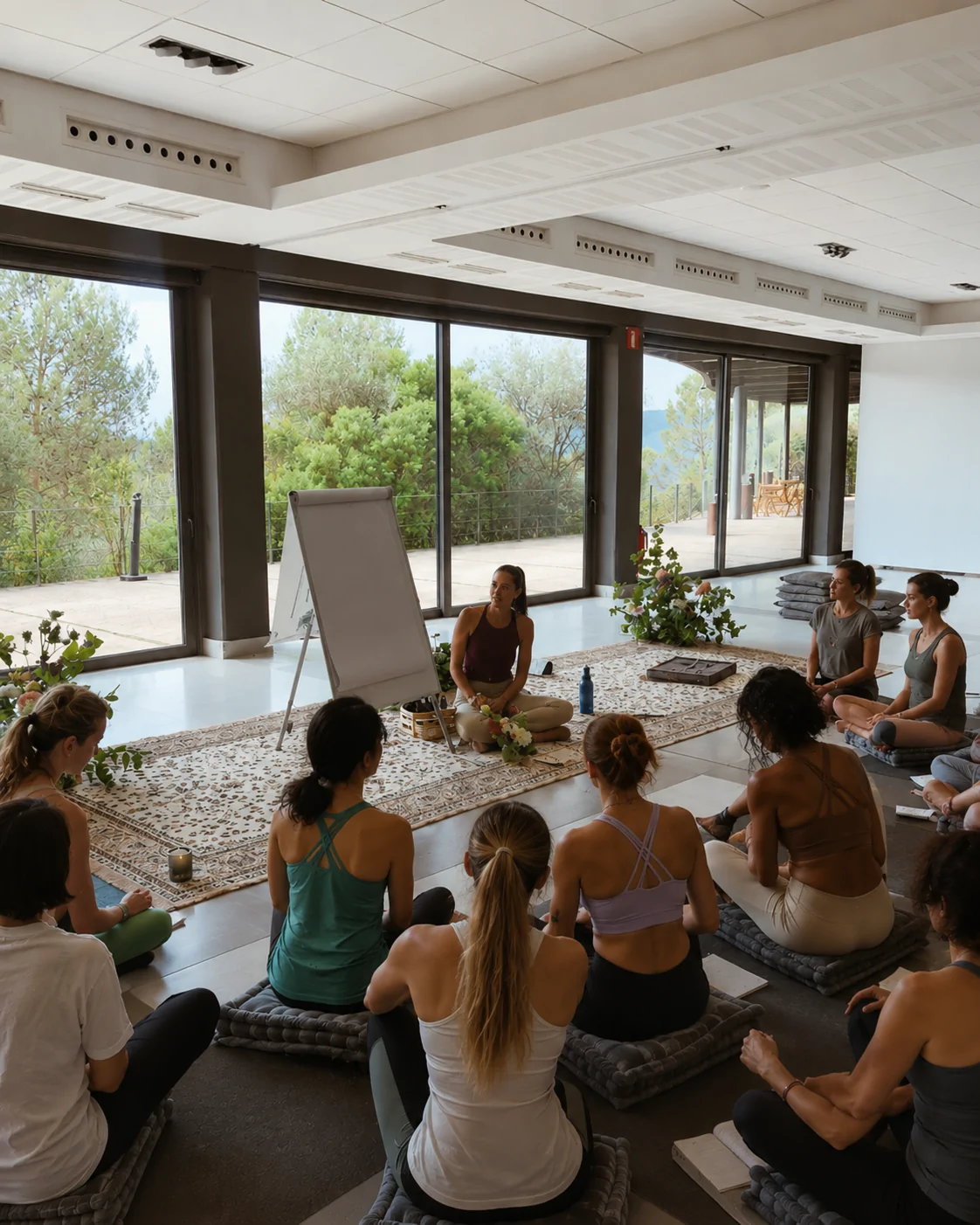
A dedicated practice space is what separates a genuine retreat center from a hotel with a yoga class added on
Who Is a Yoga Retreat Center For?
Retreat centers serve a wider range of people than the marketing imagery usually suggests.
Retreat centers are often a gentler entry point than expected — most accommodate complete beginners, with modified sequences and no requirement for prior practice. The structured environment, with a teacher guiding every session, can actually be easier to start in than a drop-in studio class.
Weekly studio classes rarely allow the kind of sustained, multi-day immersion that produces real shifts in flexibility, strength, and practice quality. A week-long retreat compresses what might take months of regular practice into a single, focused stretch of time.
This is one of the most retreat-friendly travel formats that exists. Shared meals, group classes and communal spaces create built-in social structure, and most retreat centers report a high proportion of solo bookings — going alone is the norm here, not the exception.
The structured, screen-light, decision-light environment of a retreat — meals decided, schedule set, phone optional — removes the daily cognitive load that compounds burnout. For many guests, the value isn’t the yoga itself so much as the removal of ordinary decision-making for a few days.
Not as participants, but as hosts — using a retreat center’s facilities and exclusivity to deliver their own programme to their own students. This is a distinct use case from the participant journey above, and it’s substantial enough to deserve its own section further down this guide.
Many exclusive-use retreat houses suit private bookings outside of an organised group retreat — for couples or friend groups wanting the retreat format (structured days, shared meals, a dedicated practice space) without joining someone else’s programme.
Types of Yoga Retreat — Matching Style to Goal
Within “yoga retreat” as a category, the format and focus vary considerably. Matching the right type to your goal matters more than matching the right destination.
| Retreat focus | What it involves | Best for |
|---|---|---|
| Classical / Hatha-Vinyasa retreat | Daily practice (one to two sessions), meditation, simple structured days | Anyone wanting a traditional, well-rounded introduction or deepening |
| Restorative / Yin retreat | Slow, gentle practice, longer holds, emphasis on rest and nervous system recovery | Burnout, high-stress professionals, anyone needing genuine rest over physical challenge |
| Adventure / active retreat | Yoga combined with hiking, paddleboarding, surfing, or cycling | Practitioners who want movement variety alongside yoga |
| Meditation-focused retreat | Yoga as a secondary practice; meditation, silence periods, and stillness as the core focus | Those whose primary goal is mental clarity and meditation practice rather than physical yoga |
| Digital detox / yoga retreat hybrid | Yoga combined with structured disconnection from devices | Practitioners specifically seeking a break from screen dependency alongside practice |
| Women’s retreat | Female-only group, often themed around life stage, hormonal health, or community | Women seeking a female-centred environment for connection and shared experience |
| Teacher-led / signature retreat | A specific teacher’s own students join them at a chosen venue for a bespoke programme | Students of a particular teacher wanting deeper access to their teaching outside the regular studio |
It’s worth separating meditation retreats from yoga retreats specifically, since the two get used almost interchangeably online and shouldn’t be. A meditation retreat can exist with no physical yoga practice at all — sitting practice, walking meditation, and extended periods of silence, with no asana sequencing whatsoever. A yoga retreat, by contrast, builds the day around physical practice, with meditation typically appearing as one element among several. They’re distinct but overlapping categories, and many European retreat centers now offer both as separate programmes or in combination — which is part of why “meditation retreats Europe” and “yoga retreat” searches increasingly overlap without actually meaning the same thing.
How to Choose a Yoga Retreat Center — As a Participant
A practical framework, not a wish list. Each of these affects the actual experience more than the photos on a venue’s homepage suggest.
Room configuration, setting, and daily structure shape the experience more than the photos on a homepage suggest
How to Host a Yoga Retreat — A Guide for Teachers and Organisers
For teachers and retreat organisers, the venue is one of the most consequential decisions in the entire process — it shapes the budget, the group experience, and how much of the programme you can actually control.
Yoga and Meditation Retreats Europe: A Regional Guide
For anyone researching a yoga retreat center Europe option, the regional picture matters as much as the category definition above. As a destination for yoga and meditation retreats Europe has become one of the most significant growth regions globally, driven by accessibility (most of the continent is within a two-to-four-hour flight of major hubs), well-developed retreat infrastructure, and a genuinely wide range of settings, from Mediterranean coastline to Baltic forest. For UK, Northern European and broader international travellers, this proximity is a real practical advantage over long-haul destinations like India or Bali: shorter travel time means more of a short retreat is actually spent at the retreat, not in transit.
| Region | Character | Best suited to |
|---|---|---|
| Portugal (Algarve, Alentejo) | Mature retreat infrastructure, warm climate April–October, strong yoga teacher community | First-time retreat hosts; warm-weather seekers; larger groups |
| Greece (islands and mainland) | Purpose-built yoga resorts, strong coastal and island settings, established teacher network | Teacher-led retreats wanting dedicated yoga resort infrastructure |
| Spain (Andalucía, Catalonia) | Wide range from rustic to luxury, strong hiking and nature pairing, good value | Active or adventure-style retreats; value-conscious organisers |
| Italy (Tuscany, Le Marche) | Boutique, often family-run estates, strong food culture, smaller capacity venues | Intimate groups of ten to twenty; retreats emphasising slow living and cuisine |
| Latvia and the Baltics | Forest-dominant landscape — Latvia is over 50% forest — lower cost, genuine remoteness, exclusive-use culture | Teachers wanting a distinctive, less-saturated setting; smaller exclusive groups; meditation-focused programmes |
| Austria / Alpine Europe | Mountain settings, strong wellness and spa tradition, higher price point | Premium retreats; alpine and nature-immersion focus |
On the meditation-specific side, several European regions — particularly forest and mountain settings in the Baltics, Austria, and parts of Spain — have become specifically associated with meditation retreats Europe travellers seek out as distinct from yoga-focused programmes, where the emphasis sits on silence, stillness practice, and minimal physical sequencing. For organisers planning meditation retreats across the continent, this distinction is worth keeping in the venue search itself: a venue built for an energetic Vinyasa retreat isn’t necessarily set up for a silent meditation programme, and the two should be evaluated on different criteria.
Luxury yoga retreats Europe-wide tend to cluster around a few common traits regardless of country: exclusive-use access, higher staff-to-guest ratios, on-site wellness facilities such as saunas or spas, and locations chosen for genuine remoteness rather than proximity to a tourist centre. As the European retreat market matures, that combination — privacy, natural setting, and dedicated facilities — has become the defining feature separating premium venues from standard ones.
Why Yoga Teachers Choose Narbuli for Their Retreats
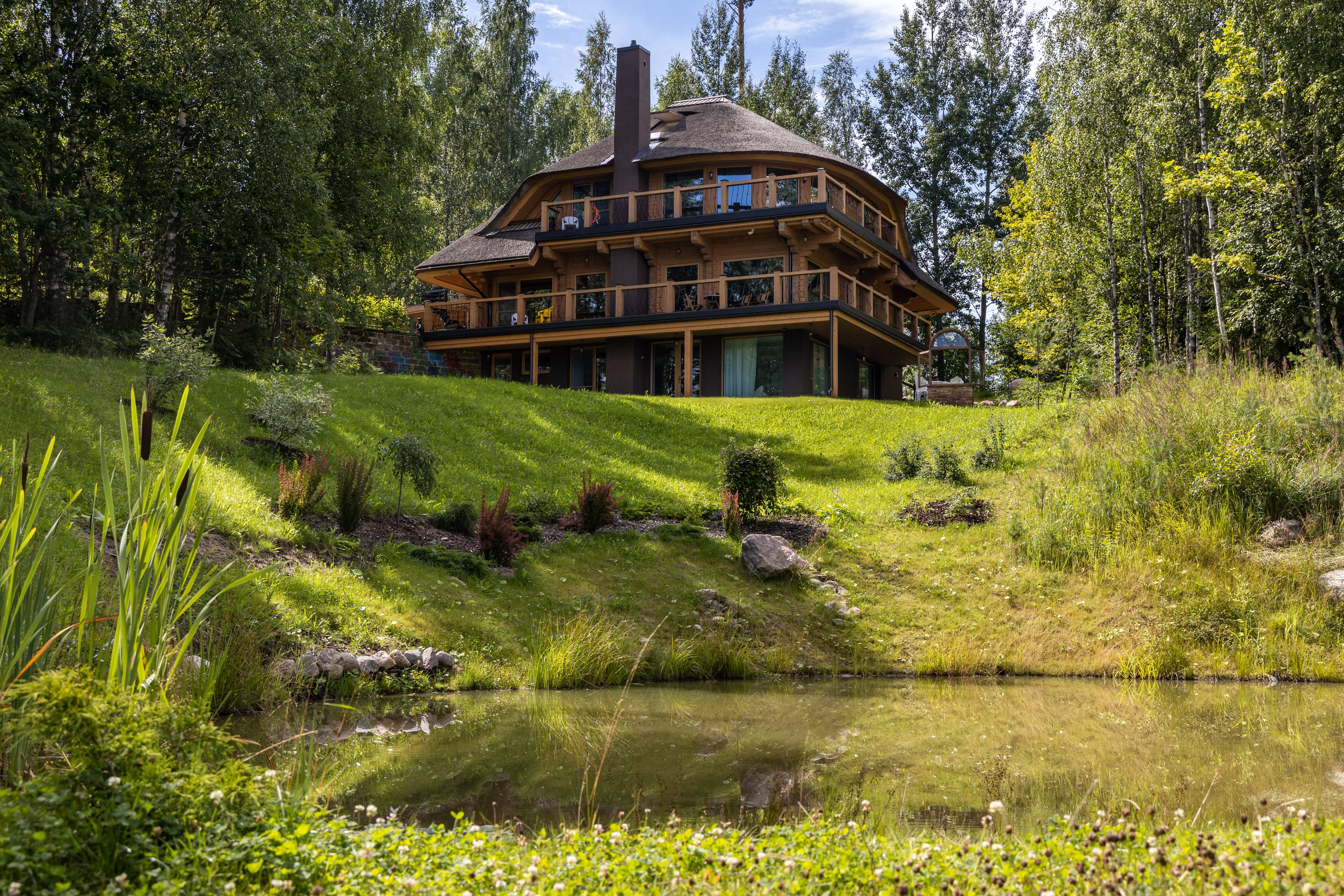
Among the venues available to European-based and international yoga teachers, Narbuli Retreat House in Latvia has a distinct profile worth understanding on its own terms. Set on a forested hillside beside a glacial lake within the Amatciems eco-village, Narbuli is built around nine rooms, each designed around a different Jungian archetype — a structural choice that gives every retreat hosted there an additional layer of intention before a single session begins. This kind of archetypal retreat house design is unusual among European venues, most of which favour neutral, generic guest rooms.
Narbuli Retreat House, Amatciems — forest, lake, and a 48 m² dedicated practice hall
What makes it specifically suited to hosting a yoga or meditation retreat
Whole-property exclusive hire. There are no other guests, ever, during a booking. Full control of every space — the practice hall, the kitchen, the lakeside terrace — for the entire duration.
A dedicated 48 m² practice hall, purpose-built for yoga and movement practice — not a converted lounge or function room.
Latvia is over half forest, and Narbuli’s hillside position beside the lake gives every part of the stay — practice, meals, free time — a backdrop that does real work in supporting the kind of presence a retreat is meant to cultivate.
Sleeping up to twelve across nine rooms, Narbuli suits the scale many independent teachers actually run at: small enough for genuine group cohesion, large enough to make the economics of hosting work.
Including a traditional Finnish sauna, a lakeside meditation terrace, and on-site psychologist-coaches available to support deeper programme work for teachers who want to incorporate psychological or shadow-work elements alongside physical practice.
Narbuli sits roughly 80 km from Riga Airport, with direct flights from London, Berlin, Oslo and other major European hubs typically running one and a half to three hours — meaning international participants can arrive without a long, fatiguing journey eating into retreat time.
For a teacher considering where to host their next retreat — particularly one wanting a setting genuinely distinct from the well-trodden Mediterranean retreat circuit — Narbuli offers a combination of exclusivity, natural immersion, and dedicated facilities that is uncommon in the Baltic region specifically. Full details on hosting your own group retreat at Narbuli are available on the group retreat page.
FAQ — Yoga Retreat Centers
Conclusion
A yoga retreat center is not one thing — it spans traditional ashrams, purpose-built wellness resorts, and exclusive-use private houses available for a single group at a time, and the right choice depends entirely on what you, or your students, actually need from the experience. For participants, the venue matters less than the teacher and the format; for hosts, the venue is one of the most consequential decisions in the entire process, shaping everything from group dynamics to programme design. Europe’s growing retreat landscape, from Mediterranean coastline to Baltic forest, now offers genuine depth of choice within a few hours’ flight of most of the continent. Whether you’re booking your first retreat or planning to host your own group for the first time, understanding the category properly is the first real step toward choosing well.
Ready to Host Your Own Retreat at Narbuli?
Whole-property exclusive hire, a dedicated 48 m² practice hall, and a forested lakeside setting in Latvia — for groups of up to twelve. Direct flights from London, Berlin, and Oslo.
What we offer