Women’s Retreat Guide 2026: Best UK & European Retreat Venues
- What Is a Women’s Retreat?
- Why Women-Only? The Case for Women’s Retreats
- Formats — What Type of Women’s Retreat Is Right for You?
- What to Look for in a Women’s Retreat Venue
- Women’s Retreats Abroad — Why European Options Are Worth Considering
- Narbuli Retreat House — A Forest Setting for Solo Women and Group Retreats in Latvia
- How to Prepare for a Women’s Retreat
- FAQ — Women’s Retreats
Looking for a Women’s Retreat in Europe?
Narbuli Retreat House in Latvia offers a forested hillside setting, a dedicated 48 m² practice hall, and whole-property exclusive hire — at a fraction of comparable UK venue costs.
The week that never ends. The mental load that clocks in before you open your eyes and clocks out — if you’re lucky — only when you finally lie down. The pattern of giving so much that the idea of stopping feels not just impossible, but vaguely irresponsible. A women’s retreat is not a luxury. It is not a wellness holiday with a spa treatment and a salad. It is a specific, intentional container designed to meet the particular needs that women carry every day: the need to stop without guilt, to be held without managing, to rest without earning it.
This guide is for two types of reader: women looking for a solo or group retreat for rest, reconnection, or self-exploration; and retreat organisers — yoga teachers, therapists, facilitators — planning to host a women-only retreat. Both will find what they need here.
What Is a Women’s Retreat?
A women’s retreat is a residential programme — facilitated or self-directed — designed for women, by women, in an environment that prioritises safety, trust, and authentic connection. The women-only aspect is not incidental: it is the core. The retreat is designed around the specific needs women bring when they finally give themselves permission to stop.
It is useful to distinguish a women’s retreat clearly from three adjacent concepts:
| Term | What it is | Key distinction |
|---|---|---|
| Women’s retreat | A structured programme (residential or day) for women only, designed around rest, restoration, reconnection, or transformation | The women-only aspect is not incidental — it is the core. The retreat is designed around the specific needs women bring |
| Spa break / wellness holiday | Self-directed leisure with spa facilities, primarily for relaxation | No facilitated programme, no intentional group work, no women-only framing |
| Women’s circle / group gathering | A single session or evening gathering of women sharing in circle | A retreat is multi-day and immersive — circle is one component of a longer programme |
Why Women-Only? The Case for Women’s Retreats
The question is worth asking directly: why a women-only space? What makes that distinction matter enough to build an entire retreat around it?
Safety and trust. Women report consistently that women-only spaces feel psychologically safer than mixed settings. The absence of male gaze, the removal of social performance around gender, and the presence of shared experience create conditions for deeper vulnerability and more authentic connection. This is not about exclusion; it is about the specific conditions under which women are able to let their guard down.
Permission to rest. Women — particularly mothers — are culturally conditioned to give, organise, and care. The guilt associated with taking time for oneself is documented and real. A women’s retreat gives explicit permission to stop — to be the one who is looked after rather than the one looking after everyone else. Getting to know the interior landscape of your own being, body, heart, mind — you start to get to know the inner conversation and how much dialogue is happening inside your own being.
Sisterhood and shared experience. There is a specific quality to being in a space with women who understand the texture of your life without needing it explained. Shared experience — motherhood, caregiving, burnout, life transitions, menopause — forms the basis of connection that is both healing and transformative.
The science of why retreats work. Nervous system regulation is the physiological reason why women’s retreats are effective. Chronic stress keeps the nervous system in sympathetic activation (fight-or-flight). A retreat provides the conditions for parasympathetic activation (rest-and-digest) over multiple days — not just hours — allowing the body to reset. Restorative practices — yoga, breathwork, yoga nidra — accelerate this process. Retreat leaders increasingly focus on nervous system regulation through practices that address the root causes of modern stress and burnout.

Formats — What Type of Women’s Retreat Is Right for You?
Women’s retreats are not a single product. The format you choose shapes the experience entirely. Here is a structured comparison:
| Format | Who it’s for | What it involves | What to look for in a venue |
|---|---|---|---|
| Solo retreat | Women seeking personal rest, reconnection, or creative space | Self-directed time, personal practice (journaling, meditation, walking), minimal programme | Whole-property hire or single-room availability; no other guests; a venue comfortable with solo stays; safety and quiet |
| Weekend retreat | Women looking for a short reset — typically 2–3 nights | A structure of facilitated sessions (yoga, meditation, circle) balanced with free time | Small group (8–12 women); comfortable accommodation; rural or nature setting; facilitated programme |
| Wild / nature retreat | Women wanting immersion in the outdoors with active elements | Walking, wild swimming, cold immersion, outdoor yoga, fire circles, camping or woodland accommodation | Access to wild landscape; outdoor space for activities; safety considerations; eco and low-impact credentials |
| Transformative / healing retreat | Women in life transitions, seeking deeper work | Psychotherapeutic elements, trauma-informed facilitation, shadow work, ceremony, extended programme (5–8 days) | Qualified and experienced facilitators; private spaces; holding environment; safe venue with no external disturbance |
| Creative retreat | Women wanting to explore creative practice | Writing, ceramics, art, music — combined with retreat elements | Studio space; creative facilities; secluded setting; good natural light; quiet |
| Facilitator-led programme | Women attending a specific programme (yoga, therapeutic writing, menopause support) | A specific teacher’s programme hosted in a retreat venue; women-only participation | Exclusive-use venue with practice space; a host who understands women’s retreat requirements; outdoor access |
For solo travellers, it is worth noting that most women’s retreats are built for solo bookings. The small group sizes — typically ten or fewer — make it easy to arrive alone and leave with a connected group.
What to Look for in a Women’s Retreat Venue
Whether you are booking a retreat or planning to host one, the venue matters more than almost anything else. Here are the criteria that make the difference between a good retreat and a transformative one.
Women’s Retreats Abroad — Why European Options Are Worth Considering
For UK women seeking a women’s retreat, the options within Britain are numerous — but they come with limitations. Domestic retreats are typically run by individual facilitators with fixed programmes and dates. Exclusive-use venues that can be hired privately for a self-directed retreat or a facilitator’s own programme are scarce and expensive.
This is why European destinations are attracting increasing attention from UK women and retreat organisers alike. The logistics are simpler than many expect, the settings are often more immersive, and the cost is typically lower.
The Baltic States — Latvia. Latvia is more than 52% forest — one of the highest proportions of any country in Europe, and significantly more than the UK’s 13%. The character of Baltic forest is distinct: old pine and spruce growing on glacial soils, with a quietness that is measurably different from the managed woodlands of southern England. For UK travellers, the logistics are straightforward: direct flights from London Heathrow, Gatwick, Stansted, Manchester, and Edinburgh to Riga run approximately 2 hours 20 minutes. From Riga, forested retreat venues are 50–90 minutes by car. For solo women travellers, Baltic forest retreats offer genuine remoteness without requiring days of travel. For retreat organisers, they offer exclusive-use properties in ancient forest settings at prices that are typically 30–40% lower than comparable UK venues.
Scandinavia. The Nordic countries offer a retreat experience that is fundamentally different from what is available in the UK. The combination of vast forests, lakes, and a cultural emphasis on friluftsliv (open-air living) creates a setting that is both restorative and distinctive. Finland’s lake district, Sweden’s archipelago, and Norway’s fjord landscapes all host women’s retreats that draw UK travellers seeking a deeper nature immersion.
Southern Europe — Portugal and Spain. Portugal and Spain offer women’s retreats that combine the benefits of a European setting with milder climates and longer seasons. The Algarve, Andalusia, and the Portuguese countryside host a growing number of women-only retreats, many of which are run by UK-born facilitators who have relocated. The flight time from the UK is comparable to travelling to the north of Scotland, but with significantly more reliable weather and a different cultural rhythm.
The European Advantage. The case for looking beyond Britain is simple: access to exclusive-use venues, lower costs, genuine remoteness, and the specific character of different European landscapes. For UK women, the European retreat market offers a breadth of choice that the domestic market cannot match — particularly for solo travellers and independent retreat organisers seeking a private setting for their own programme.
Narbuli Retreat House — A Forest Setting for Solo Women and Group Retreats in Latvia
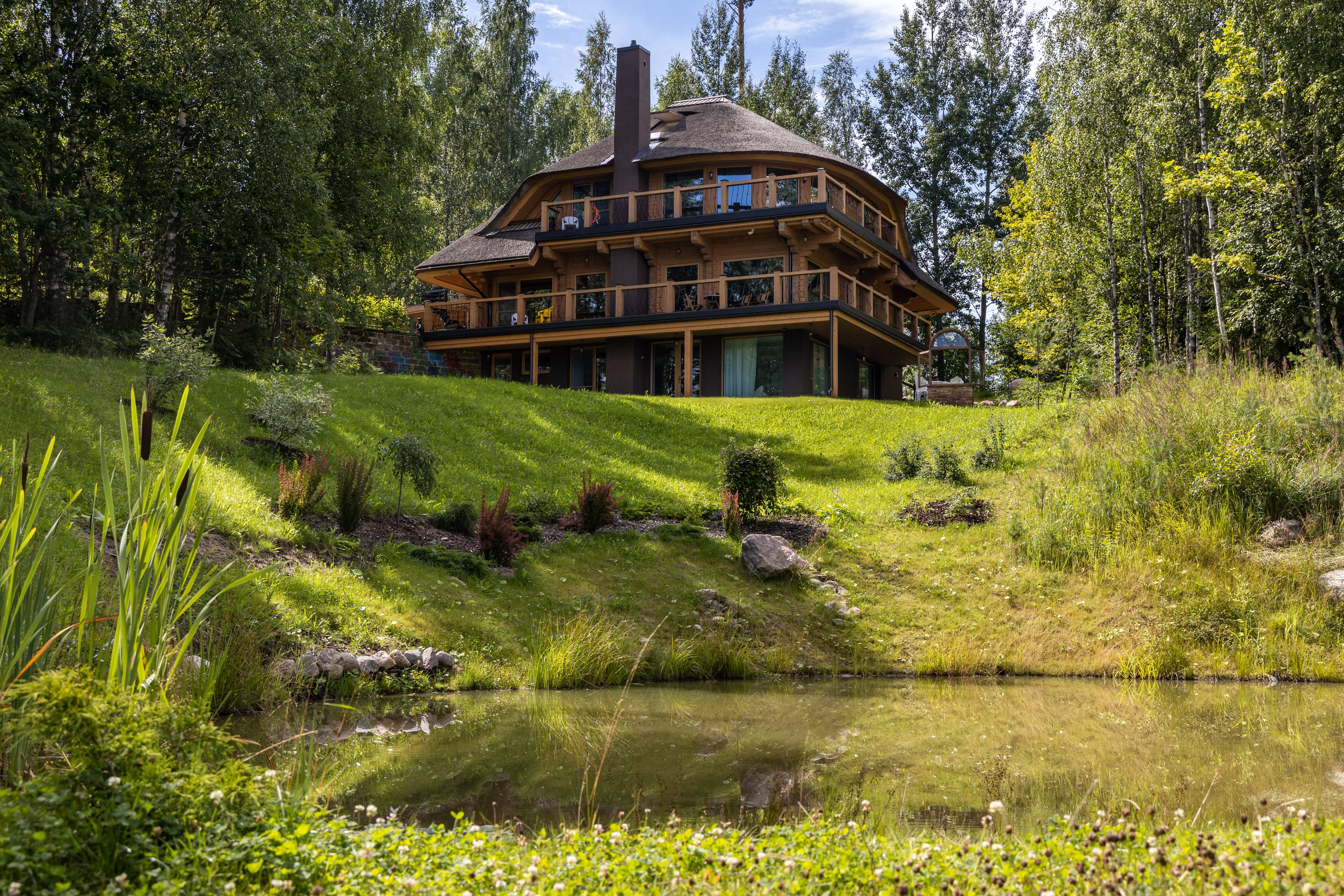
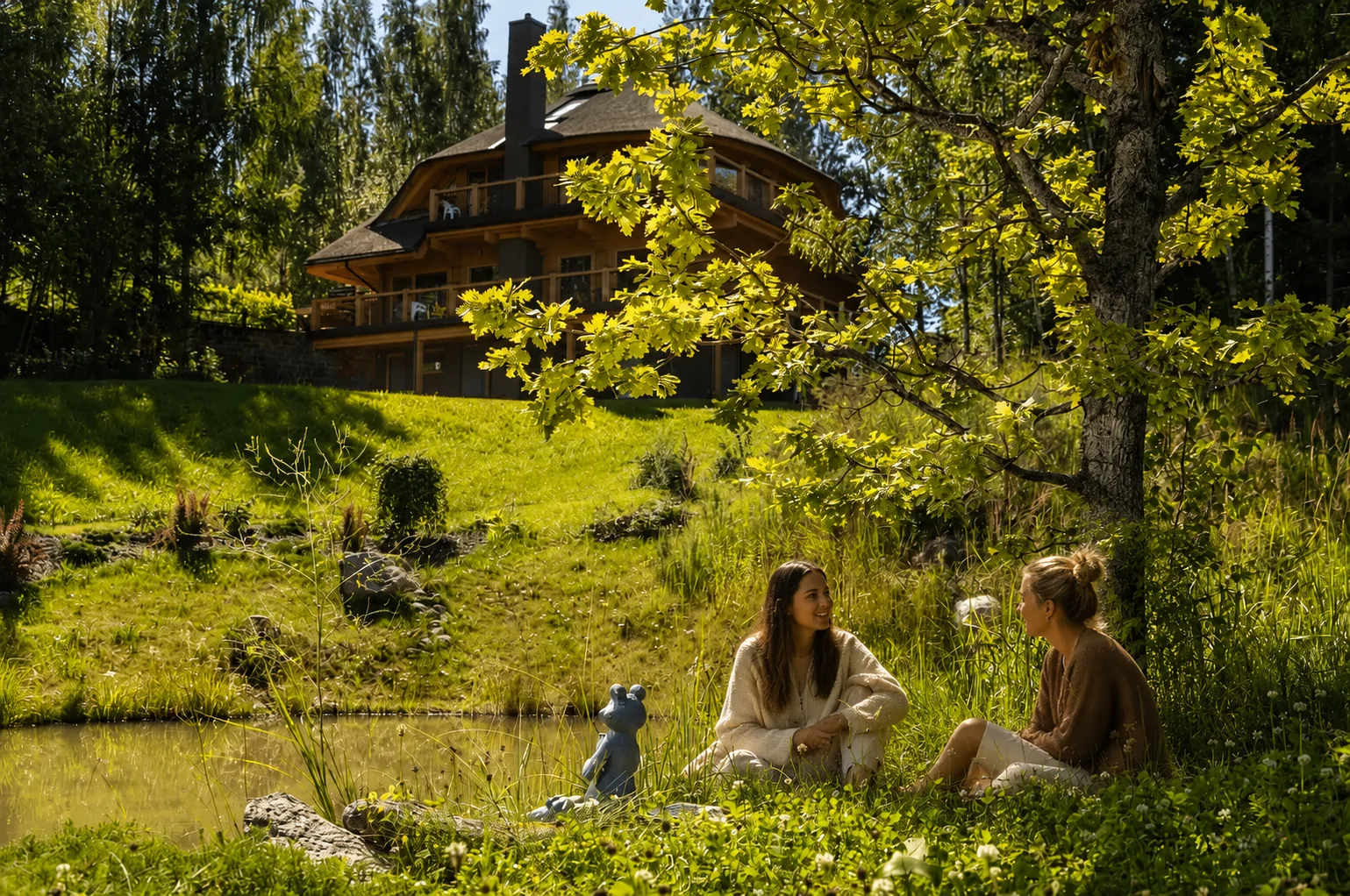
Narbuli Retreat House sits on a forested hillside within the Amatciems eco-settlement in Latvia, approximately 80 kilometres from Riga. The property operates exclusively on a whole-house hire basis — there are no other guests during a booking, making it one of the few genuinely private forest retreat houses accessible to UK travellers within a three-hour journey from London.
For solo women travellers, Narbuli offers something genuinely rare: a whole forest retreat house taken for yourself — or shared with a small group of friends — without the social dynamics of a shared retreat programme. The nine rooms are each designed around a distinct psychological archetype (the King, the Jester, the Magician, the Warrior, the Shadow, the Self, the Lover, and two Inner Children — a boy and a girl), which gives even unstructured solo time a layer of intention. A sauna, a glacial lake, forest trails directly from the house, and quiet that is only broken by the forest itself. There is no imposed schedule. For a woman seeking rest, safety, and genuine solitude, the setting itself does the work.
The solo retreat process begins with a 30–50 minute consultation to determine which archetypal room best suits your current challenges. On arrival, guests receive a comprehensive guide to exercises and practices for self-work, some with audio guidance. There is free time for walking, reading, swimming, cycling, or simply resting — and an optional end-of-retreat consultation to discuss integration.
For retreat organisers — yoga teachers, therapists, facilitators, or anyone leading a women’s programme — Narbuli’s value is in its combination of scale, exclusivity, and environment. The property accommodates up to 12 participants across nine rooms. There is a dedicated 48m² practice hall suited to yoga, movement, or group work, which can accommodate up to 20 people for lectures, plus a 40m² terrace under a transparent roof. The forested hillside setting means the forest is not a feature you walk to — it is the immediate physical context of everything that happens at the house. Facilitation support is available on-site, including psychologist-coaches for programmes involving deeper psychological work.
From a logistics perspective: flights from London to Riga are direct and frequent (multiple airlines, typically £80–£180 return, book 8–12 weeks ahead). Transfers from Riga Airport to Narbuli take approximately 50 minutes. Full details on group retreat hire are available at “Host your retreat.
How to Prepare for a Women’s Retreat
Practical guidance for both audiences.
FAQ — Women’s Retreats
Conclusion
A women’s retreat is not a luxury. It is a specific, intentional structure designed to meet needs that women carry every day: the need to stop without guilt, to be held without managing, to rest without earning it. Whether you are looking for a weekend with a small group of women who understand, a wild week in the woods, a solo retreat in an ancient forest, or a venue to host your own women’s programme, the same principle applies: the retreat is the container that makes stopping possible. The rest is what happens when you give yourself permission to be in it.
Ready to Plan Your Women’s Retreat at Narbuli?
Whole-property exclusive hire, a dedicated 48 m² practice hall, and a forested lakeside setting in Latvia — for solo guests and groups of up to twelve. Direct flights from London, Berlin, and Oslo.
What we offer