
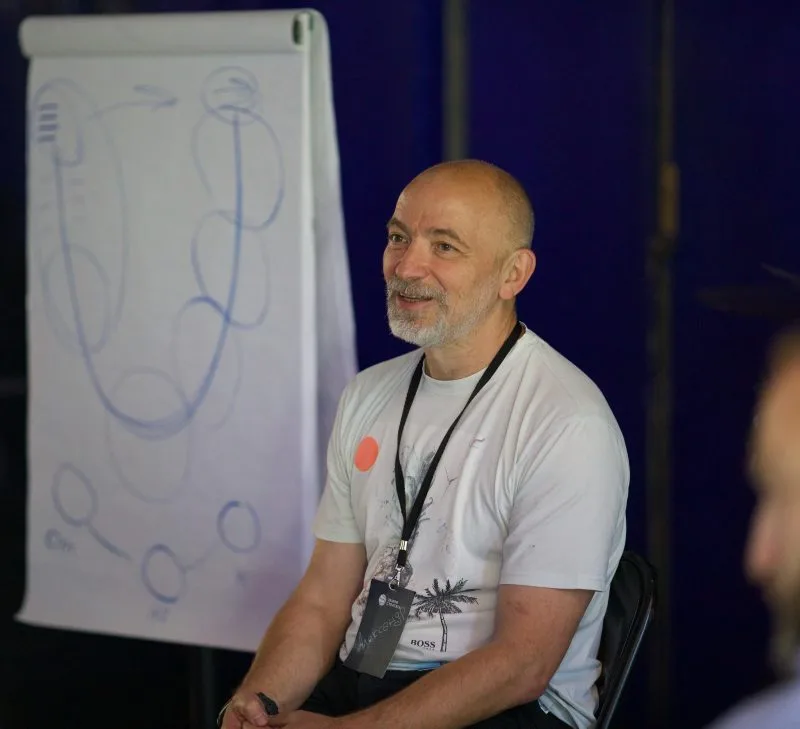
Executive Retreat Venue & Leadership Retreat
Looking for somewhere private to hold a leadership offsite? Explore Narbuli — an exclusive-use retreat house in the Latvian countryside.
An executive retreat is a private offsite where senior leaders step away from the office to think clearly and make decisions that don’t fit into a normal working week. In the UK and Europe, that’s the only meaning in everyday use. In the US, the same phrase is also an established term within the addiction-treatment industry, describing a discreet, high-end rehab programme for executives — a genuinely separate meaning, not a variation on the same idea.
A well-run executive retreat venue combines three things: a level of privacy an office can’t offer, a facilitator who knows how to work with senior groups, and a setting substantial enough to change the register of the conversation. Get any one of those wrong and the retreat becomes an expensive change of scenery rather than a genuine reset.

A private countryside setting — the starting point for any genuine executive retreat
What an executive retreat is — and how it differs from a leadership retreat
An executive retreat is a private, focused gathering of senior leaders — often the C-suite or board — away from the office, built around strategic thinking, decision-making and, frequently, executive coaching. It is not a team-building day, and it is not the addiction-treatment programme the same phrase describes in parts of the US. A handful of closely related terms get used almost interchangeably, so it’s worth being precise about what each one actually means:
| Term | What it is | Key distinction |
|---|---|---|
| Executive retreat | A private gathering of senior leaders — often C-suite or board level — centred on strategic thinking and decision-making | The seniority and privacy of the group is the defining feature, not team-building activities |
| Leadership retreat / leadership offsite | A broader gathering of an organisation’s leadership layer, often including senior managers beyond the C-suite | Wider participant group, usually with a stronger leadership-development component alongside the strategic work |
| Team offsite | A gathering for a whole team or department, not specifically leadership | Focused on team cohesion and collaboration rather than senior strategic decisions |
| Board / strategy retreat | A formal gathering of a board or top team for a specific strategic decision | Narrower purpose and audience, usually shorter and more agenda-driven than a general executive retreat |
| “Executive retreat” (US treatment-industry sense) | A discreet, high-end rehabilitation programme for executives — an established term within the US addiction-treatment industry | Entirely unrelated to corporate strategy — a genuine naming collision, not a synonym |
Why executive and leadership retreats work
Not because a nicer room makes decisions easier by itself — but because of what changes when senior leaders are physically removed from the environment that produced the problem in the first place:
- Decision fatigue drops. Senior leaders make a disproportionate number of high-stakes calls in a normal week. Distance from the office — from the inbox, the drop-in meetings, the constant small decisions — is consistently linked to clearer, less reactive strategic thinking.
- Psychological safety improves. Research associated with Harvard’s Amy Edmondson links candid, high-quality strategic conversation to environments where people feel safe disagreeing openly — something a normal boardroom culture rarely provides by default.
- Poor leadership has a real cost. Around half of employees cite poor leadership and management as a main reason for leaving a job — a leadership retreat is one of the few interventions that addresses this directly, at the level where it starts.
- Attendees report a genuine effect, not just a nice few days. Surveyed participants consistently report that time away from the office positively affects both their strategic clarity and their wellbeing — and that some of their best ideas arrive away from a scheduled meeting, not during one.
- The setting itself does some of the work. The same environmental-priming logic behind why people think differently on a walk, or in an unfamiliar room, applies at a larger scale — a genuinely different physical setting changes the register of the conversation that happens in it.
💡 None of this requires a packed agenda. Some of the most useful executive retreats protect more unstructured time than structured time — the thinking tends to happen in the gaps, not only in the sessions.
Retreat formats: which one do you actually need
“Executive retreat” sits within the broader world of corporate retreat formats, but it covers several genuinely different scenarios in its own right. Knowing which one you’re planning changes almost everything else — the venue, the facilitation, the length.
| Format | Who it’s for | What it involves | What to look for |
|---|---|---|---|
| Board / strategy retreat | C-suite and board | Focused, high-stakes decision-making on a small number of strategic questions | Total privacy, a boardroom-grade practice space, a facilitator experienced with senior groups |
| Executive coaching retreat | An individual executive or a small group | 1:1 or small-group coaching combined with unstructured reflection time | A qualified executive coach or psychologist, quiet spaces for 1:1 work |
| Leadership offsite / leadership development retreat | The extended leadership layer — heads of department, senior managers | A mix of strategic work and leadership-skill development | Breakout spaces, an experienced facilitator, some structured group work |
| Founder / CEO retreat | A solo founder or CEO, or a small group of peers | Personal strategic thinking time away from day-to-day operations, with optional coaching | Private accommodation, minimal imposed structure, solitude with the option of facilitation |
| Multi-day residential leadership programme | A leadership cohort over several days | Input sessions, group work and genuine downtime combined | Exclusive-use venue, on-site accommodation, a dedicated practice space |
What ties the residential formats together is exclusivity: a founder taking a house alone for a reset and a leadership cohort running a four-day programme both need the same thing — a venue nobody else is sharing that week. Narbuli, our retreat house in Latvia, is set up around exactly that: the whole property is taken by one group at a time, whether that’s one person or a leadership team of a dozen or more. If the goal is wellness rather than strategic work, our guide to meditation retreats in Europe is a better starting point than an executive-focused venue.
Choosing an executive retreat venue: a practical checklist
Most “top venues” listicles compare amenities. What actually determines whether a retreat works is closer to this:
- Exclusivity and privacy. Whole-property hire with no other guests is essential for confidential strategic or personnel conversations — ask directly whether the venue can guarantee exclusive use for your dates, not just a private room within a shared building.
- Space that scales from boardroom to breakout. A genuine practice or meeting room, not a repurposed hotel conference suite — ask about capacity, natural light, and how easily the space reconfigures between plenary and small-group work.
- Controlled connectivity. Reliable Wi-Fi that the group can also choose to switch off from, so disconnection is a decision the retreat makes together, not an accident that frustrates half the room.
- Distance from the office without being inaccessible. Far enough to genuinely change the mental register, close enough that travel doesn’t consume a working day either side.
- Facilitation credentials, where coaching is involved. Ask which qualification the facilitator holds — recognised routes include ICF accreditation or a psychology background — and how they handle confidentiality within the group.
For the fuller picture on what makes a good venue beyond these executive-specific points, our retreat house guide covers the wider criteria. And if you’re the one organising rather than attending, our guide on how to host a retreat walks through the logistics side in more depth.
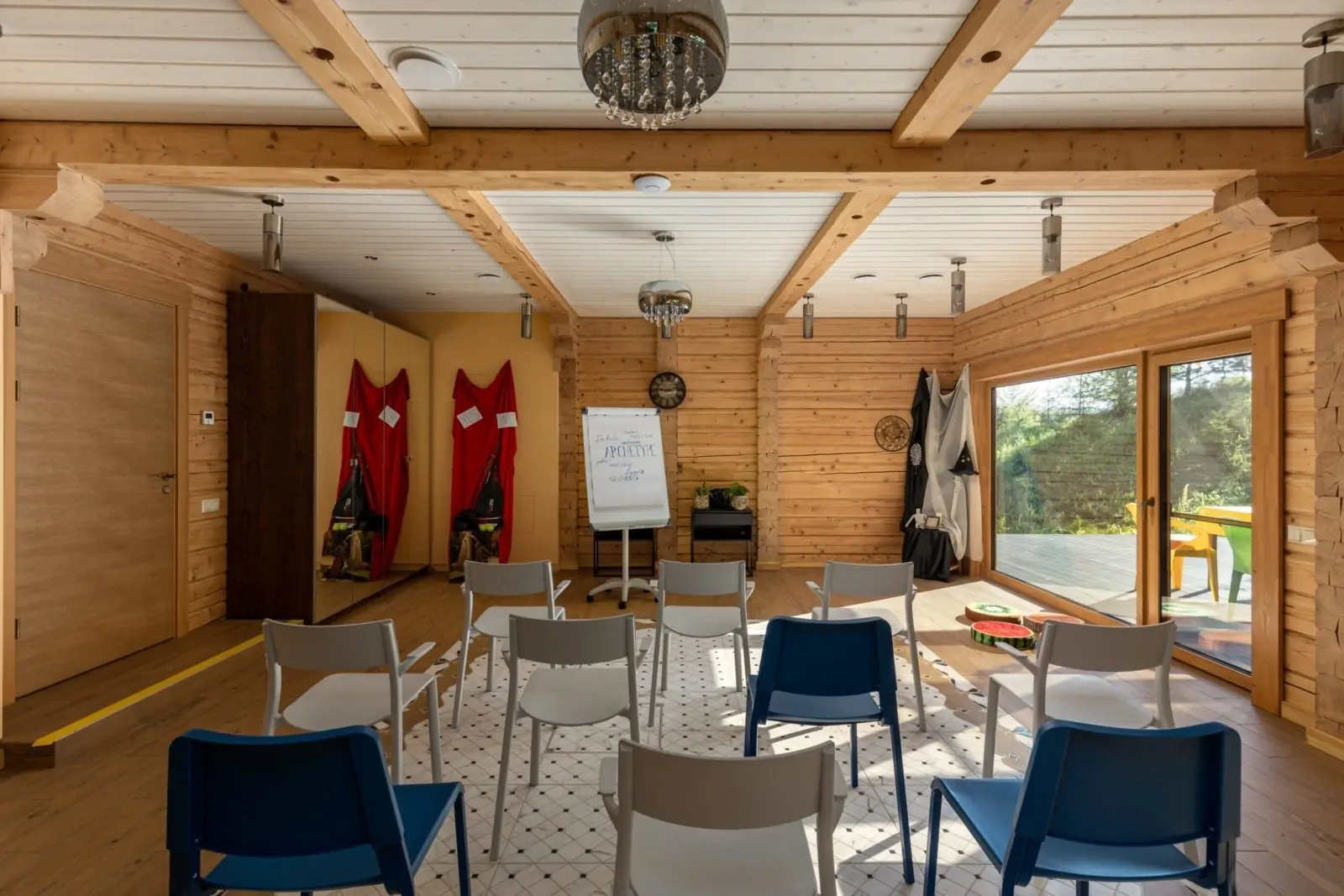
A dedicated practice room at Narbuli — panoramic windows, heated floor, and space that scales from plenary to breakout groups
Finding an executive retreat venue in the UK
If you need something in the UK specifically, a few honest starting points: several online marketplaces list venues by region, which is useful for browsing by location and budget. Specialist meeting-venue providers cover central London well, for day sessions where a residential stay isn’t needed. And residential country-house venues in the Cotswolds and Home Counties remain the default choice for a UK-based leadership retreat — usually £150–£500 per person per day, depending on exclusivity and season.
The trade-off worth knowing before you commit: genuine whole-property exclusivity at the country-house end of the UK market is increasingly hard to book at short notice, and comes at a price point that’s pushing some organisers to look further afield for the same level of privacy — which is where a European option starts to make practical sense.
Executive retreats beyond Britain: organising in Latvia
If UK availability, price, or the level of exclusivity you need doesn’t line up, Latvia is a genuinely practical alternative — closer than most UK leaders expect. Direct flights from London and more than thirty other European cities land in Riga, and from there it’s around two hours by road to a setting that feels properly removed from ordinary working life.
Narbuli Retreat House is the specific example worth naming: a private countryside venue perched on a hilltop above a forest lake, within Latvia’s Amatciems eco-settlement, available exclusively to one group at a time — no other guests, no shared facilities. Nine rooms across four floors accommodate up to eighteen participants, which suits a solo founder taking the whole house for a personal reset just as well as a leadership team running a multi-day programme. A dedicated practice room, a wood-fired sauna, and on-site facilitation support for programmes that combine strategy work with deeper coaching make it a working venue, not just somewhere pleasant to stay. Full details on hiring the house for a group are at retreatlatvia.com/en/host-a-retreat. If you’re weighing Narbuli against other options, our guide to the best group retreats in Europe covers the wider landscape.
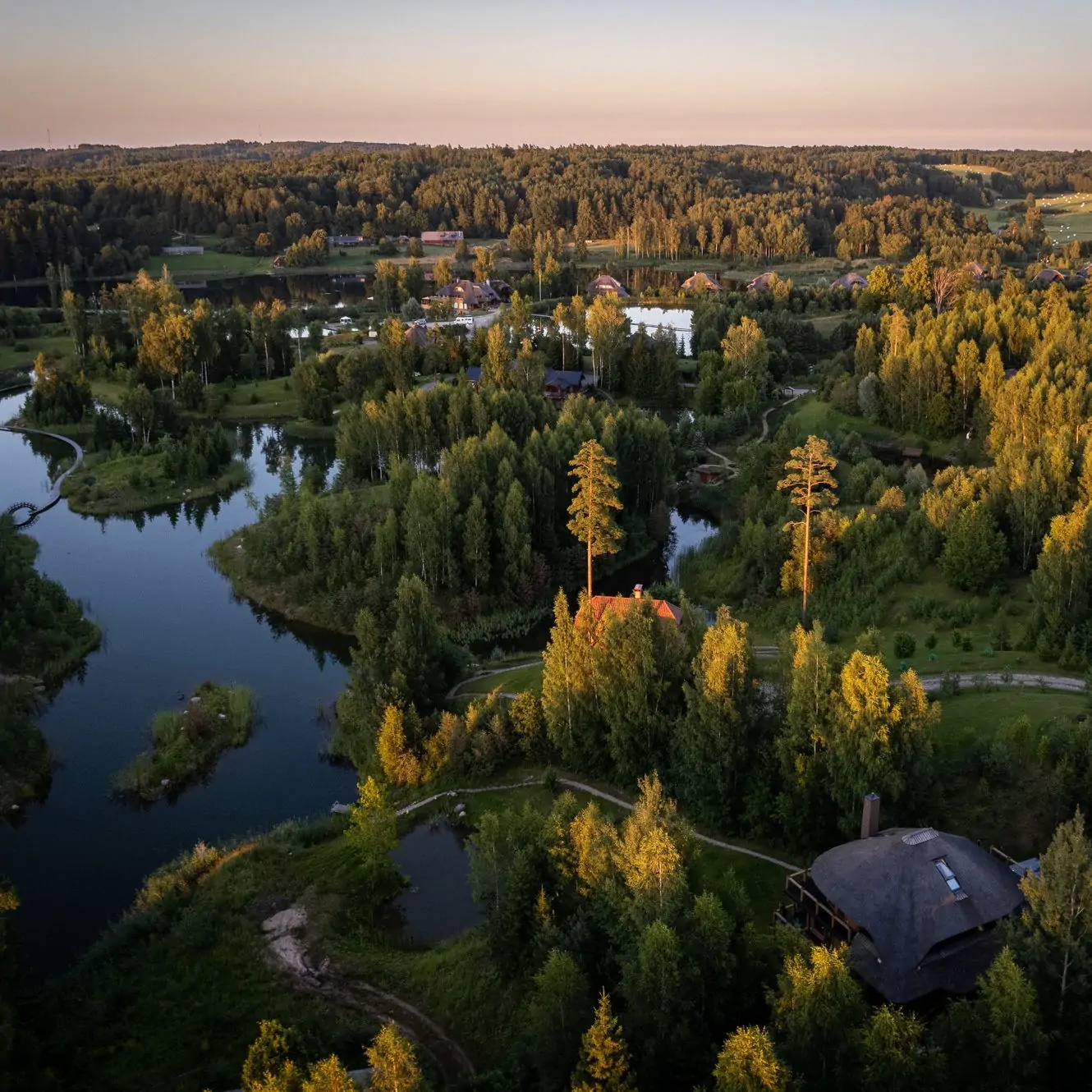
Narbuli Retreat House, Amatciems, Latvia — around two hours from Riga International Airport
✈ Teams have come to Narbuli from the UK, Germany, Sweden, Norway, Switzerland, the Netherlands, Finland, Denmark and France — the flight distance is smaller than most people assume before they check.
FAQ — frequently asked questions
Conclusion and checklist
An executive retreat isn’t a single fixed format — it can be a two-day board strategy session, a solo founder’s reset, or a multi-day leadership development programme. What ties the genuine, corporate-strategy meaning together is distance: physical distance from the office that creates the mental distance senior decisions actually need.
Whether the next step is a day-only session in central London or a longer, exclusive-use stay somewhere the privacy is total rather than partial, the same checklist applies: real exclusivity, space that fits the work, and — if coaching is involved — a properly qualified facilitator. The setting doesn’t make the decisions. It makes better ones possible.
Planning an executive or leadership retreat?
Narbuli offers exclusive-use hire of a private retreat house in Latvia — nine rooms, a dedicated practice room, and on-site support for up to eighteen leaders.