Meditation Retreats Europe: Solo, Silent & Group Guide (2026)
- What Is a Meditation Retreat?
- The Science — Why Sustained Meditation Works
- Silent Retreats — What “Silence” Actually Means
- Meditation Traditions — The Wider Landscape
- Meditation Retreat Formats
- Where to Organise a Meditation Retreat — Checklist
- Finding a Meditation Retreat Near You
- Meditation Retreats Beyond Britain
- Narbuli Retreat House
- FAQ

Looking for a Meditation Retreat Venue in Europe?
Narbuli Retreat House in Latvia offers a forested hillside setting, a dedicated 48 m² practice hall, and whole-property exclusive hire — at a fraction of comparable UK venue costs.
If you are deciding whether to book a meditation retreat for yourself, or working out where to host one for a group, this guide sets out what the practice actually involves, what the research says about sustained meditation, and where — in the UK and in Europe — you can find or organise one.
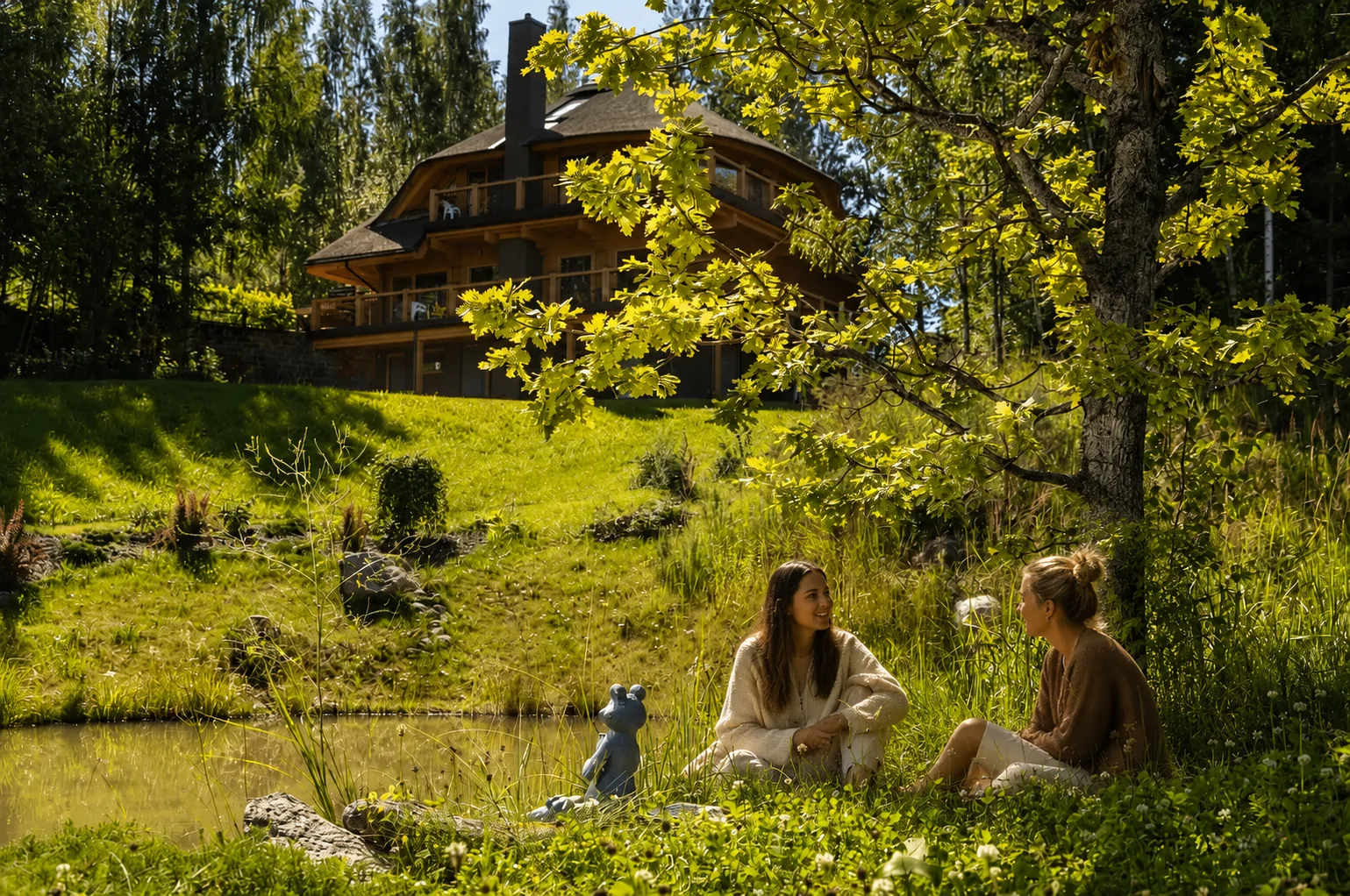
A meditation retreat gives structured, uninterrupted time to practice — the sitting is the point, not the setting around it
What Is a Meditation Retreat?
Most people who meditate do it in fragments — ten minutes on a commute, a guided session before bed, squeezed between everything else. A meditation retreat removes the fragmentation. It is a residential or day programme, facilitated or self-directed, built around sustained, uninterrupted meditation practice, usually away from phones, work and daily routine. The difference between a short daily app session and several days of continuous practice is closer to the difference between learning to swim in a busy pool in short bursts and spending a week in open water with nothing else to do: the depth is simply not available in fragments, however consistent they are.
“Meditation retreat” gets used loosely, though, and it is worth separating from three terms it regularly gets confused with:
| Term | What it is | Key distinction |
|---|---|---|
| Meditation retreat | A structured programme centred on sustained meditation practice, with the schedule, silence and setting built to support it. | Meditation is the core activity, not an add-on — the days exist to support it. |
| Yoga and meditation retreat | A retreat combining physical yoga practice with meditation sessions, usually in roughly equal measure. | Meditation shares billing with an active physical practice rather than being the sole focus. |
| Wellness retreat | A broader programme that may include spa treatments, nutrition coaching, massage and light activity alongside meditation. | Meditation is one wellness element among several, not the organising principle. |
| Silent retreat | A retreat, often but not always meditation-focused, conducted under a vow or convention of noble silence for most or all of its duration. | The silence itself — not just the meditation technique — is the defining structural feature. |
The Science — Why Sustained Meditation Works
The clinical grounding for meditation practice is specific and datable, rather than a vague wellness pedigree. In 1979, Jon Kabat-Zinn, a molecular biologist at the University of Massachusetts Medical School, developed what became Mindfulness-Based Stress Reduction (MBSR) — an eight-week programme built around sustained meditation practice, including a full-day retreat conducted largely in silence. Kabat-Zinn deliberately stripped the programme of religious framing to make it usable in a clinical, secular setting, and MBSR remains the most studied meditation protocol in modern medicine, with the Center for Mindfulness at UMass Medical School still running training programmes from it today.
Sustained meditation practice is associated with measurable reductions in cortisol and a shift from sympathetic (“fight or flight”) to parasympathetic (“rest and digest”) nervous system activity — an effect research suggests becomes more pronounced with longer, uninterrupted practice than with short daily sessions alone.
Neuroimaging research has linked sustained mindfulness practice to changes in grey matter density in regions associated with learning, memory and emotional regulation, and to reduced activity in the default mode network — the network associated with mind-wandering and rumination.
Studies of intensive, week-long retreats have found measurable improvements in sustained attention and working memory that persist beyond the retreat itself — improvements that are harder to produce through short, fragmented practice spread across months.
The case for a retreat over an app is dose and continuity: a week of several hours’ daily practice, without work notifications interrupting it, produces a depth of practice that is difficult to replicate in ten-minute daily sessions.
Silent Retreats — What “Silence” Actually Means
“Silent retreat” is often used as a rough synonym for “meditation retreat,” but the two are not the same thing, and it is worth being precise before booking one. Silence, in this context, usually means noble silence: no speaking, no eye contact intended as communication, and often no reading, writing or phone use either, for a set period of the retreat.

Silence is a structural feature of some retreats, not a synonym for meditation practice itself
Meditation Traditions — The Wider Landscape
“Meditation retreat” also spans a much wider range of underlying practice than the phrase suggests. Vipassana (insight meditation) is a specific, traditional lineage, typically taught over ten days under strict silence following the method popularised by S. N. Goenka. Zen retreats centre on seated meditation (zazen) within a Japanese Buddhist framework. Mantra-based retreats, including Transcendental Meditation programmes, use a repeated sound or phrase as the primary technique. Secular mindfulness or MBSR-style retreats deliberately teach the technique without attaching it to any particular tradition. None of these is more “correctly” a meditation retreat than the others — they are different routes into the same underlying skill, and the right one depends on how much structure, tradition and silence a given practitioner actually wants.
Meditation Retreat Formats — And Where People Actually Go for Them
Beyond tradition, retreats also differ by who they are built for and how much structure they impose. The table below sets out the main formats and what to check before booking or organising each one.
| Format | Who it’s for | What it involves | What to look for |
|---|---|---|---|
| Solo meditation retreat | Individual travellers seeking rest, mental clarity or a first structured practice | Self-directed sitting practice, journalling, walking meditation; minimal or no imposed programme | Whole-property hire; single-occupancy rooms; a venue genuinely comfortable with unstructured solo stays |
| Vipassana (insight) retreat | Committed practitioners willing to take on a demanding, traditional structure | Typically ten days, noble silence throughout, several hours of seated meditation daily | A recognised lineage or teacher; simple, often dormitory-style accommodation is standard |
| Guided mindfulness / MBSR-style retreat | Beginners wanting a secular, evidence-based introduction | Guided sitting and walking meditation, body-scan practice, some periods of quiet, less rigid than Vipassana | A qualified, ideally clinically trained facilitator; a quiet but not necessarily silent environment |
| Teacher-led programme retreat | Participants in a specific teacher’s themed programme | A facilitator’s own curriculum hosted in a retreat venue, often with some social time built in | Exclusive-use venue with a dedicated practice space and a host used to retreat logistics |
| Group / organiser-hosted retreat | Meditation teachers, therapists and yoga teachers bringing their own participants | The teacher’s own curriculum, hosted in a venue chosen to support it, typically with exclusive use | Whole-property hire, a proper practice hall, and a host who understands retreat scheduling and catering |
Solo and organiser-hosted formats depend on the same underlying thing: a venue prepared to hand over the whole property, rather than run alongside other guests or groups. Narbuli Retreat House, a forested, whole-house property in Latvia, is a working example of a setting built around exactly that — suited both to a single traveller taking the property on their own and to a facilitator bringing their own group programme. Its fuller detail belongs in the European section below, where the practical logistics of getting there sit alongside it.
Where to Organise (or Find) a Meditation Retreat — A Practical Checklist
Rather than a route into a particular tradition, this section is for anyone deciding where to hold or attend a retreat. Six things are worth checking before booking any venue.
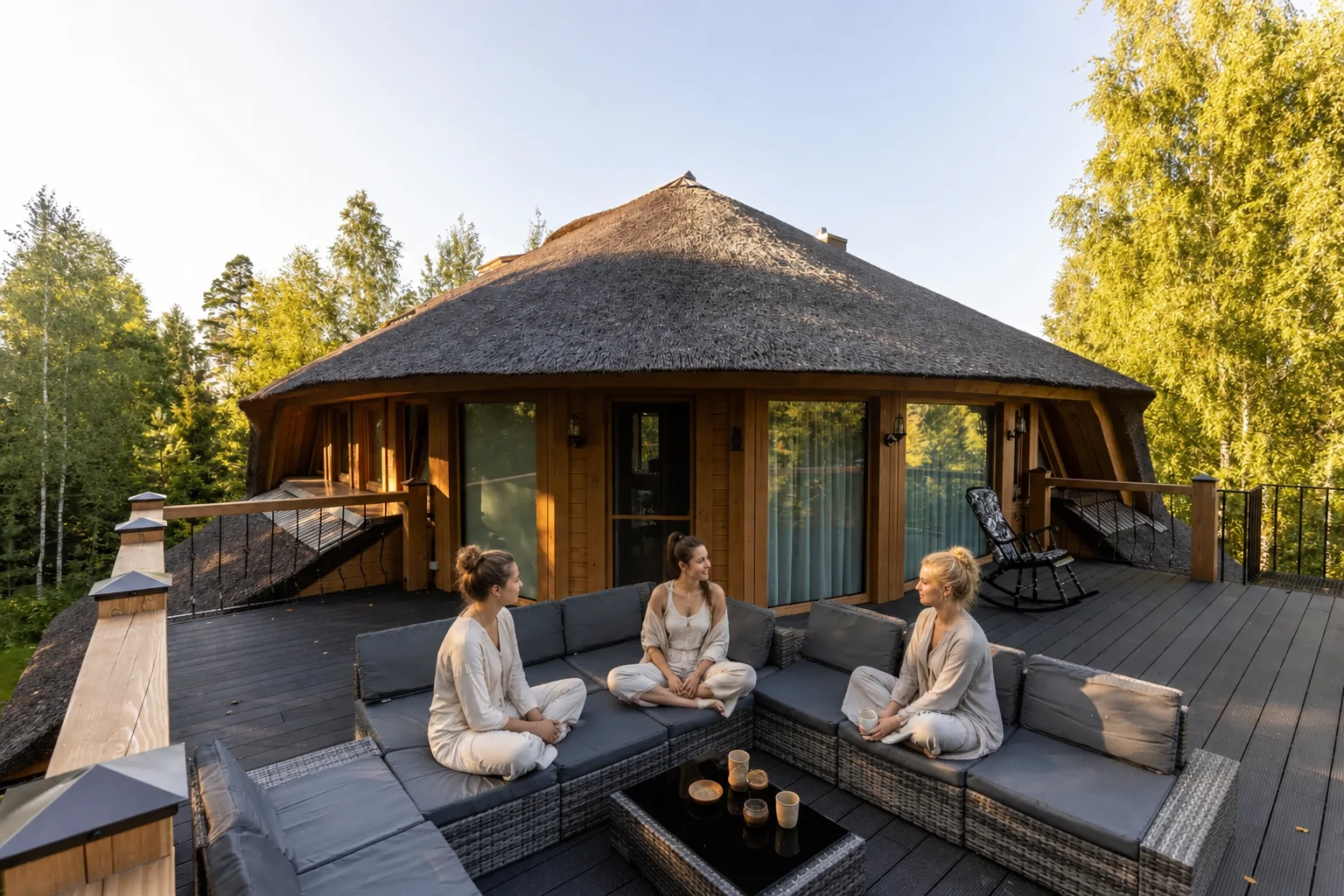
Narbuli Retreat House is a useful worked example against this exact list: a hillside forest setting in Latvia with whole-property exclusive use, nine single-occupancy rooms, on-site facilitation support that includes psychologist-coaches for programmes combining meditation with deeper psychological work, and a 48 m² practice hall for group sessions.
Finding a Meditation Retreat Near You
For UK-based readers, the strongest options tend to cluster around established Buddhist and MBSR-lineage centres — a handful of long-running venues scattered across the West Country, the South East and further north, most rooted in a specific tradition and built up over decades. They range from gentle, single-day introductions to mindfulness through to demanding, silent, week-long or ten-day residential courses, and most are well organised, with an established teaching schedule and a loyal returning audience.
There is, however, a genuine shortage in the UK of exclusive-use, private meditation retreat houses suited to independent teachers who want to bring their own secular or eclectic programme to a quiet, self-contained venue, rather than book into an established centre’s own schedule and dormitory-style accommodation. Venue costs also tend to run higher in the UK than elsewhere in Europe: hire of an exclusive-use retreat house is generally more expensive in the South West or South East of England than in comparable settings further east on the continent. This combination — limited private inventory and a higher price point — is one reason UK-based retreat leaders increasingly look further afield, particularly to the Baltic states, where a country like Latvia offers exclusive-use venues at a noticeably lower cost alongside more privacy and space than a shared centre can offer.
Meditation Retreats Beyond Britain — Organising a Retreat in Latvia
For retreat organisers who conclude that the UK does not have quite the right venue, Latvia is worth a look on the numbers alone. More than 52% of the country is forest — one of the highest proportions in Europe, against roughly 13% in the UK. Baltic forest also has a distinct character: old pine and spruce growing on glacial soils, with a quiet that is measurably different from the busier Mediterranean retreat markets — Spain, Portugal, Italy, Greece — that dominate most “meditation retreats europe” searches.
Logistics are simpler than many UK-based readers expect. Direct flights from London Heathrow, Gatwick, Stansted, Manchester and Edinburgh to Riga take around two hours twenty minutes, and forested retreat venues typically sit fifty to ninety minutes from Riga by car. For solo travellers, Baltic retreats offer genuine remoteness without a long-haul journey; for organisers, exclusive-use properties at prices typically 30–40% lower than comparable Western European venues.
Narbuli Retreat House — A Quiet Forest Setting for Solo Practice and Group Retreats
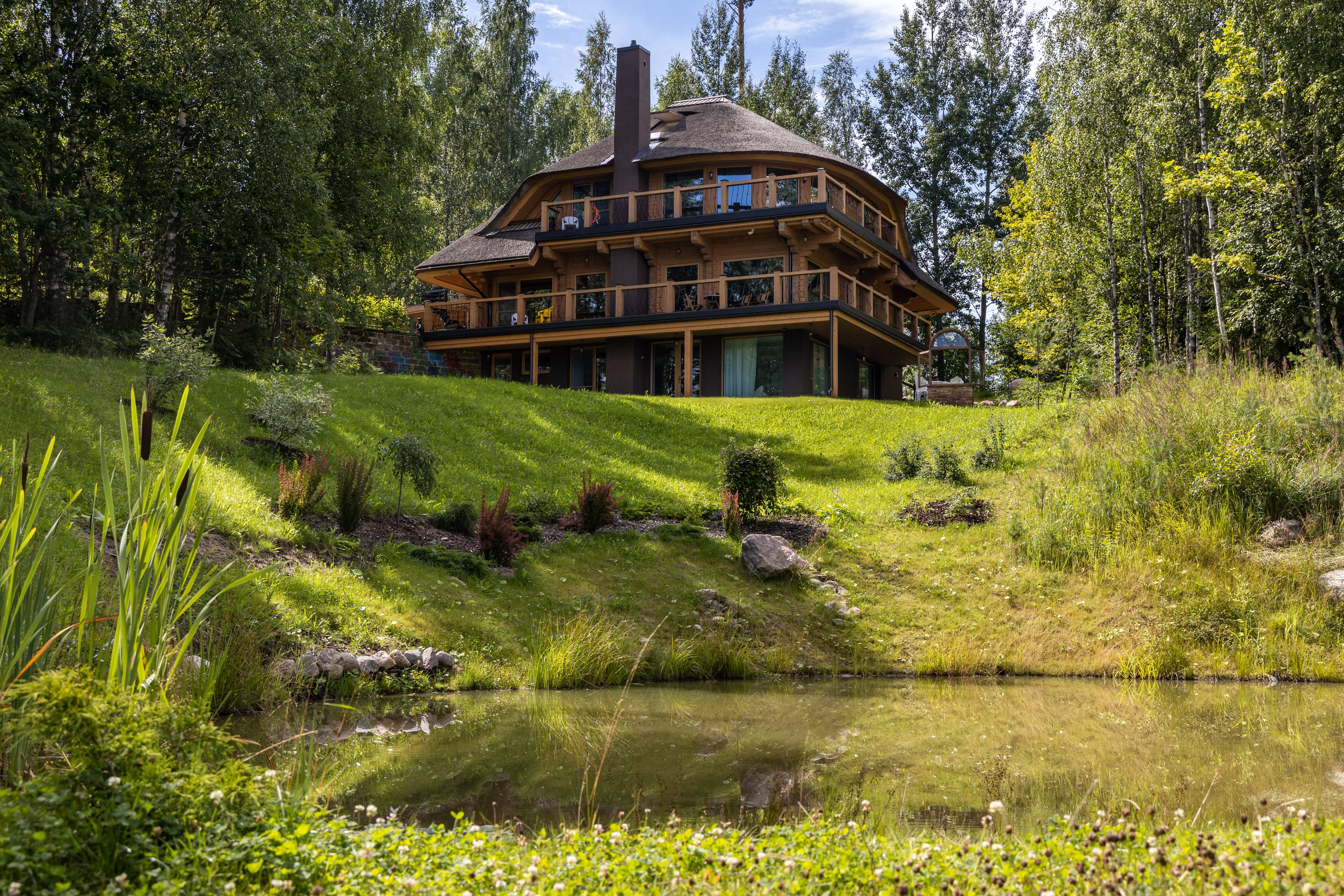
Narbuli Retreat House is a specific, named example of this kind of venue: a forested hillside setting within the Amatciems eco-settlement, roughly 80 kilometres from Riga, run on a whole-house, exclusive-use basis — no other guests present during a booking. Its nine rooms, each designed around a distinct psychological archetype, suit both a solo traveller taking the whole property for uninterrupted practice and a small group.
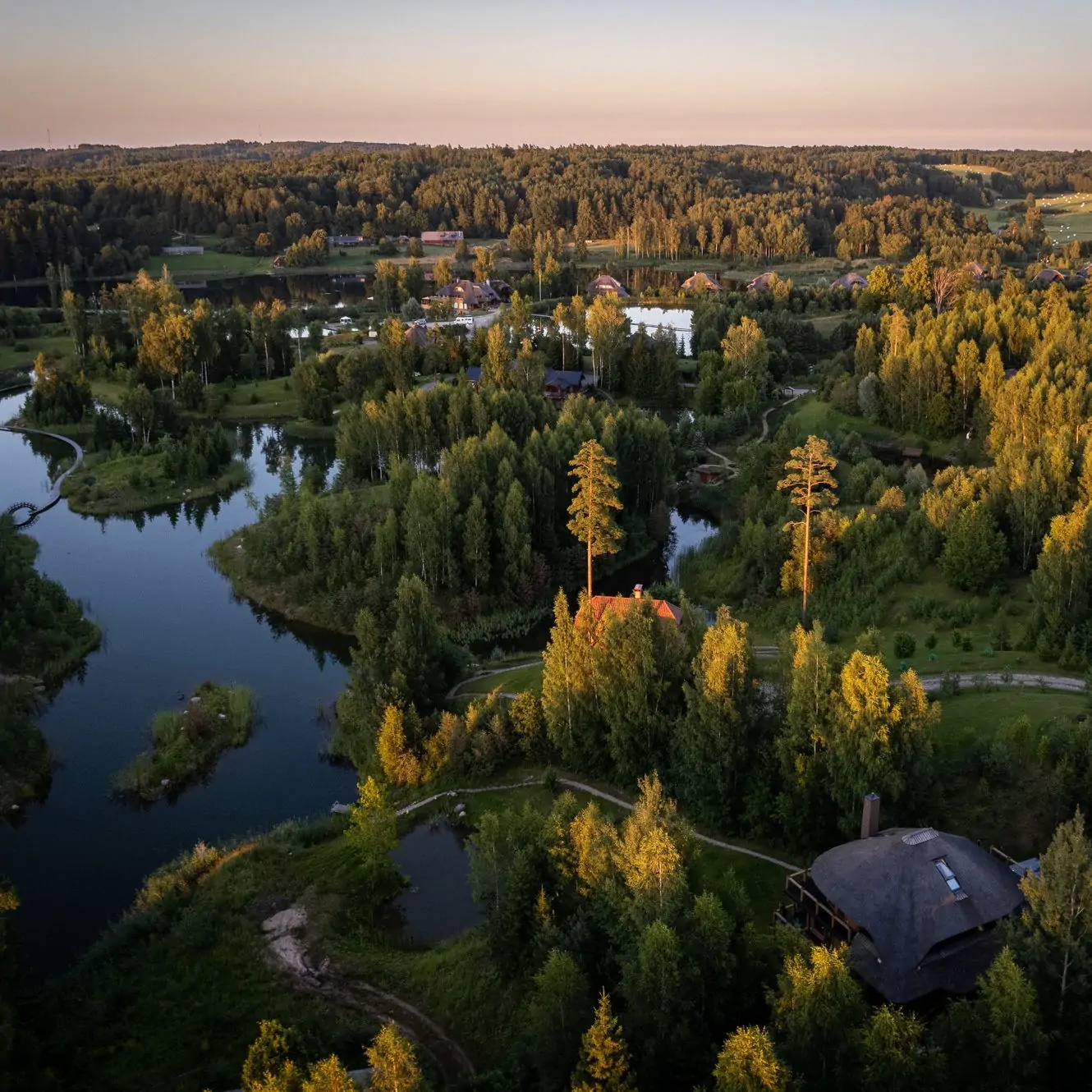
Narbuli Retreat House, Amatciems — forested hillside setting, 80 km from Riga
What meeting the checklist looks like in practice
Whole-property exclusive use — no other guests during a booking, for either a solo stay or a group — and nine single-occupancy rooms suited to sustained, individual practice.
A dedicated 48 m² practice hall, capacity for up to twelve participants, and on-site facilitation support — including psychologist-coaches for programmes combining meditation with deeper psychological work.

The practice hall and interior spaces at Narbuli — built for seated group work, not converted from a lounge
Flights from London to Riga typically run £80–£180 return, best booked eight to twelve weeks ahead, and the transfer from Riga Airport takes around fifty minutes. Full details on hiring the property for a group retreat are set out on the group retreat page, and the main Narbuli overview is at retreatlatvia.com.
FAQ — Meditation Retreats
Conclusion
Meditation is a trainable skill, not an aesthetic. What a retreat offers is not a nicer setting to meditate in, but the sustained, uninterrupted time that fragmented daily practice cannot provide — the difference between short bursts and depth. Whether the next step is a rigorous ten-day Vipassana course, a gentler mindfulness introduction, or the right European venue for a programme you want to host, the same principle applies: distance from ordinary distraction is what makes the practice work. The retreat is simply the structure that creates that distance and holds it long enough to matter.
Ready to Plan a Meditation Retreat at Narbuli?
Whole-property exclusive hire, a dedicated 48 m² practice hall, and a forested hillside setting in Latvia — for solo guests and groups of up to twelve. Direct flights from London in around 2 hours 20 minutes.
What we offer