Forest Therapy Centre: What It Is, and Where to Experience One
- What Is a Forest Therapy Centre? (And What It Isn’t)
- The Science — Benefits of Forest Bathing
- Forest Grounding — A Practice Within Forest Bathing
- Green Bathing — The Wider Umbrella Term
- Forest Bathing Retreats — Formats
- Where to Organise a Forest Retreat — Checklist
- Finding Forest Bathing Near You
- Forest Therapy Centres Beyond Britain
- Narbuli Retreat House
- FAQ
Looking for a Forest Therapy Centre in Europe?
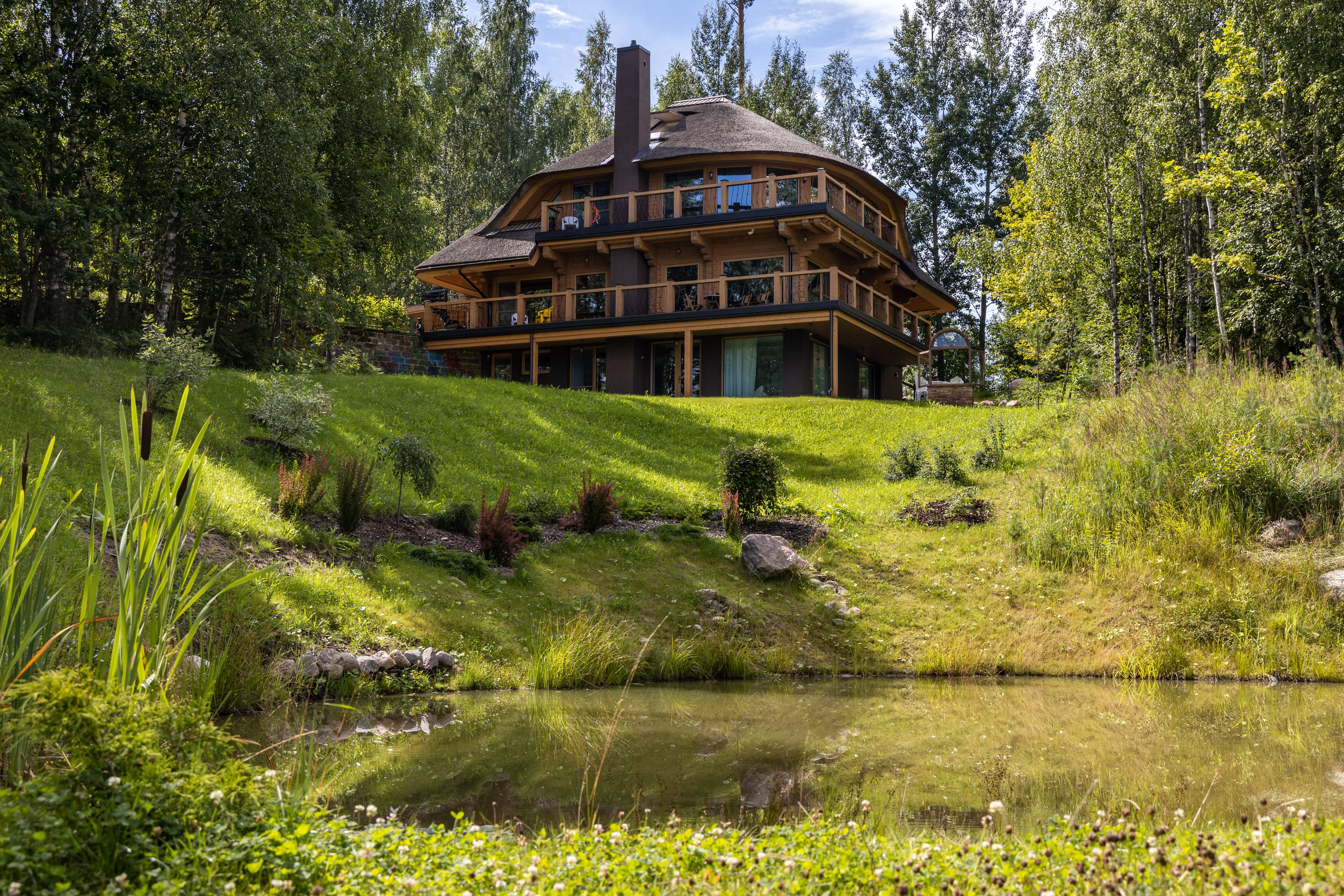
Narbuli Retreat House in Latvia offers a forested hillside setting, a dedicated 48 m² practice hall, and whole-property exclusive hire — at a fraction of comparable UK venue costs.
If you are deciding whether to book a forest bathing retreat for yourself, or working out where to organise one for a group, this guide sets out what the practice actually involves, what the research says about it, and where — in the UK and in Europe — you can experience or host one.
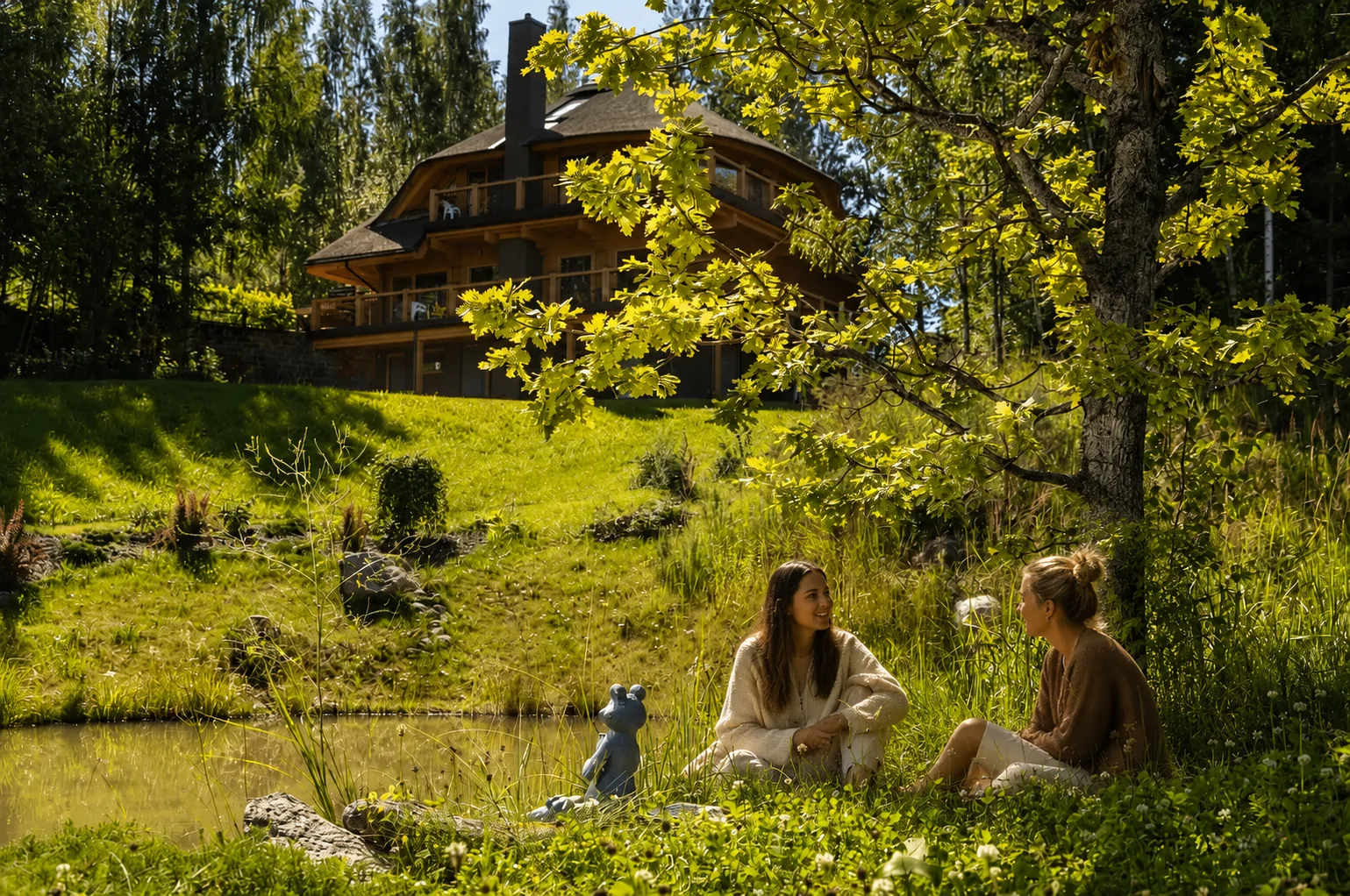
A forest therapy centre gives structured, sustained access to a forest — the trees are the active ingredient, not a backdrop
What Is a Forest Therapy Centre? (And What It Isn’t)
Forest therapy, known in Japan as Shinrin-yoku or “forest bathing,” is far more than a simple walk in the woods; it is a slow, mindful immersion in the natural world that serves as a profound antidote to the stresses of modern life. By engaging all five senses—feeling the cool moss beneath one’s fingertips, inhaling the earthy scent of damp soil, listening to the rustle of leaves in the canopy, and observing the dappled light filtering through the branches—participants consciously reconnect with their environment. This practice is supported by a growing body of scientific research, which demonstrates that phytoncides, the natural oils released by trees, can significantly lower cortisol levels, reduce blood pressure, and boost the immune system. More than just a health trend, forest therapy is a gentle invitation to slow down, find stillness, and remember our intrinsic connection to the ecosystem that sustains us, ultimately offering a holistic path to both mental clarity and physical well-being.
| Term | What it is | Key distinction |
|---|---|---|
| Forest therapy centre | A place or retreat structured around forest-based therapeutic practice: forest bathing, grounding, guided sensory immersion. | The forest is the active ingredient; the centre or retreat exists to give structured access to it. |
| Forest bathing / shinrin yoku | A specific practice: slow, mindful, sensory immersion in a forest, typically two to four hours, often guided. | A technique a forest therapy centre or retreat offers — not the venue itself. |
| Forest grounding | Direct physical contact with the forest floor — barefoot walking, touching bark or soil — sometimes paired with a present-moment sense of mindfulness. | A single technique within forest bathing, not a synonym for the whole practice. |
| Green bathing | A broader, less formal synonym for immersion in any green natural space — woodland, parkland, hedgerow — not necessarily dense forest. | Forest bathing is a specific, denser form of green bathing; green bathing is the wider umbrella term. |
The Science — Benefits of Forest Bathing
Forest bathing has a specific, documented history rather than a vague wellness pedigree. In 1982, Akiyama Tomohide, then an official at Japan’s Ministry of Agriculture, Forestry and Fisheries, introduced shinrin yoku as a national health initiative, encouraging citizens to spend unhurried time in forests as a matter of public health policy. Japan has since designated more than sixty official forest therapy sites, and Japanese researcher Qing Li has spent much of the following four decades building the physiological evidence base behind the practice.
Trees, particularly conifers, release airborne compounds called phytoncides. Exposure to them has been linked in Japanese research to measurable increases in natural killer (NK) cell activity — part of the immune system’s response to infection. A single two-hour forest walk has been shown to raise NK cell activity for up to thirty days afterwards.
Forest bathing research consistently records reductions in cortisol, blood pressure and heart rate beyond what light exercise and fresh air alone would explain, alongside a measurable shift from sympathetic (“alert”) to parasympathetic (“rest and digest”) nervous system activity, often tracked through heart rate variability.
Attention restoration theory, developed by Rachel and Stephen Kaplan, holds that certain natural environments restore the directed attention that screens, traffic and decision-making steadily deplete. Forest immersion is among the environments most consistently shown to do this.
Research consistently reports reductions in self-reported anxiety, depression and anger, alongside improvements in mood and sleep quality. In the UK, forest bathing now features in some NHS green social prescribing schemes, where GPs refer patients to nature-based activities alongside conventional treatment.
Forest Grounding — A Practice Within Forest Bathing
Forest grounding, sometimes called earthing in this physical sense, means direct contact between the body and the forest floor: bare feet on soil or moss, hands on bark, or simply lying down among the trees. It is one specific technique offered during a forest bathing session, not a separate practice or a rebranding of forest bathing as a whole.

Grounding — bare feet on soil or moss — is one technique within a forest bathing session, not a synonym for it
Green Bathing — The Wider Umbrella Term
Green bathing describes mindful, sensory immersion in any green natural space — a park, a hedgerow, a garden, a stretch of common land — rather than dense forest specifically. Forest bathing is best understood as its most studied and most intensive form: the same underlying practice of slow, sensory attention, applied in an environment with a denser tree canopy, richer phytoncide exposure and, generally, stronger measured effects. For readers without straightforward access to a proper forest, green bathing in a local park or along a tree-lined path offers a lighter version of the same practice, and is a reasonable place to start.
Forest Bathing Retreats — Formats, and Where People Actually Go for Them
“Forest bathing retreat” covers a wider range of experiences than the name suggests, from an unstructured solo stay to a facilitator’s own multi-day programme hosted in a forest setting. The table below sets out the main formats and what to check before booking or organising each one.
| Format | Who it’s for | What it involves | What to look for |
|---|---|---|---|
| Solo forest therapy stay | Individual travellers wanting personal rest, grounding or reflection | Self-directed time in the forest; journalling, walking, grounding practice; minimal or no programme | Whole-property hire; a venue genuinely comfortable with unstructured solo stays |
| Facilitated forest bathing session | Anyone wanting a guided shinrin yoku experience | Led by a trained guide; structured sensory invitations; typically two to four hours | A guide certified with a recognised body (see checklist below) |
| Small group retreat | Friends or a small community, four to twelve people | Shared forest time, communal meals, optional facilitated sessions | Exclusive-use property at the right scale; simple or self-catering meals |
| Teacher-led programme retreat | Participants in a themed programme (yoga, writing, coaching plus forest) | A facilitator’s own programme hosted in a forest venue | Exclusive-use venue with a practice space and a host who understands retreat logistics |
| Corporate forest day | Work teams seeking a change of environment or a reset | Structured outdoor sessions combined with team time | Exclusive use, reliable connectivity for any admin, catering on-site |
Solo and teacher-led formats both depend on the same underlying thing: a venue prepared to hand over the whole property, rather than run alongside other guests. Narbuli Retreat House, a forested, whole-house property in Latvia, is a working example of a setting built around exactly that — suited both to a single traveller taking the property on their own and to a facilitator bringing their own group programme. Its fuller detail belongs in the European section below, where the practical logistics of getting there sit alongside it.
Where to Organise (or Find) a Forest Retreat — A Practical Checklist
Rather than a route into training as a guide yourself, this section is for anyone deciding where to hold or attend a retreat. Six things are worth checking before booking any venue.
Narbuli Retreat House is a useful worked example against this exact list: a hillside forest setting in Latvia with direct forest access from the house itself, whole-property exclusive use, on-site facilitation support that includes psychologist-coaches for programmes combining forest therapy with deeper psychological work, and a 48 m² practice hall for group sessions.
Finding Forest Bathing Near You
For those seeking forest therapy in the UK, guided sessions are widely available across the country, with numerous public woodlands and national parks offering regular programmes led by trained practitioners. These locations range from ancient broadleaf forests in the south to expansive mixed woodlands and remote pine-covered highlands in the north, each providing a distinct atmospheric character shaped by its native trees and terrain. In addition to public forests, private countryside estates and dedicated wellness venues also host their own sessions, typically offering shorter, more accessible experiences that require no overnight stay. For those willing to travel farther, however, the quality of the experience can improve dramatically: deeper immersion in a truly wild setting, away from roads and crowds, allows for a more profound sensory connection with nature. Retreat centres like Narbuli Retreat House, nestled in remote, unspoiled landscapes, offer extended programmes where participants can spend several days in serene isolation, fully surrendering to the rhythm of the forest. While local parks and tree-lined green spaces can serve as a gentle introduction to the practice, it is often worth venturing beyond the city limits for a richer, more restorative encounter with the natural world.
Forest Therapy Centres Beyond Britain — Organising a Retreat in Latvia
For retreat organisers who conclude that the UK does not have quite the right venue, Latvia is worth a look on the numbers alone. More than 52% of the country is forest — one of the highest proportions in Europe, against roughly 13% in the UK. Baltic forest also has a distinct character: old pine and spruce growing on glacial soils, with a quiet that is measurably different from managed English woodland, where paths, farmland edges and road noise are rarely far away.
Logistics are simpler than many UK-based readers expect. Direct flights from London Heathrow, Gatwick, Stansted, Manchester and Edinburgh to Riga take around two hours twenty minutes, and forested retreat venues typically sit fifty to ninety minutes from Riga by car.
Narbuli Retreat House — A Forest Setting for Solo Guests and Group Retreats
Narbuli Retreat House is a specific, named example of this kind of venue: a forested hillside setting within the Amatciems eco-settlement, roughly 80 kilometres from Riga, run on a whole-house, exclusive-use basis — no other guests present during a booking. Its nine rooms, each designed around a distinct psychological archetype, suit both a solo traveller taking the whole property and a small group.
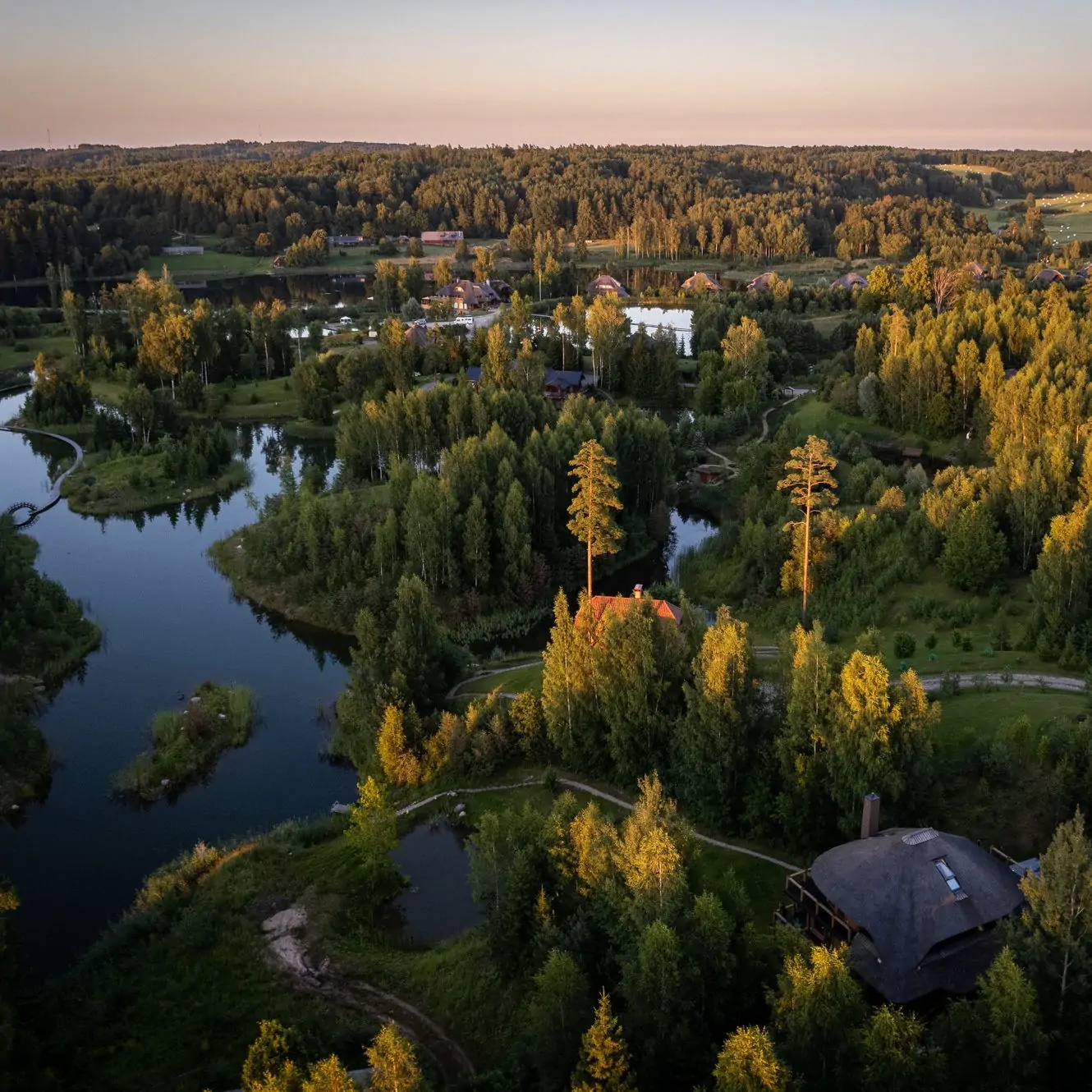
Narbuli Retreat House, Amatciems — forested hillside setting, 80 km from Riga
What meeting the checklist looks like in practice
Direct forest access from the house itself, and whole-property exclusive use — no other guests during a booking, for either a solo stay or a group.
A dedicated 48 m² practice hall, capacity for up to twelve participants, and on-site facilitation support — including psychologist-coaches for programmes combining forest therapy with deeper psychological work.

The practice hall and interior spaces at Narbuli — built for group sessions, not converted from a lounge
Flights from London to Riga typically run £80–£180 return, best booked eight to twelve weeks ahead, and the transfer from Riga Airport takes around fifty minutes. Full details on hiring the property for a group retreat are set out on the group retreat page, and the main Narbuli overview is at retreatlatvia.com.
FAQ — Forest Therapy Centres
Conclusion
A forest therapy centre is not a single fixed thing — it can be a public forest running guided walks, a practitioner leading local sessions, or a private retreat house built entirely around forest access. What ties the genuine, nature-based meaning together is the forest itself doing measurable physiological work: lowering cortisol, shifting the nervous system, restoring attention. Whether the next step is a short guided session close to home or a longer, exclusive-use stay somewhere the forest is the entire setting rather than a backdrop, the same checklist applies: the right forest, direct access to it, and — if it’s guided — a properly credentialed facilitator. The forest does the rest, given enough time in it.
Ready to Experience a Forest Therapy Centre at Narbuli?
Whole-property exclusive hire, a dedicated 48 m² practice hall, and a forested hillside setting in Latvia — for solo guests and groups of up to twelve. Direct flights from London in around 2 hours 20 minutes.
What we offer