

Forest Retreat Guide: Eco, Solo & Group Retreats (2026)
- What Is a Forest Retreat?
- Why the Forest Works — The Science of Shinrin Yoku
- What Makes a Forest Retreat ‘Eco’?
- Forest Retreat Formats
- How to Choose a Forest Retreat Venue
- Forest Retreats in the UK
- Forest Retreats Beyond Britain
- Narbuli Retreat House
- How to Prepare for a Forest Retreat
- FAQ
Looking for a Forest Retreat in Europe?
Narbuli Retreat House in Latvia offers a forested hillside setting, a dedicated 48 m² practice hall, and whole-property exclusive hire — at a fraction of comparable UK venue costs.
Stepping into a dense forest is physiologically different from entering any other natural environment. The light softens and fractures through the canopy. The air cools and carries a distinct, earthy scent—a complex mixture of soil, moss, and the volatile organic compounds released by the trees. Most significantly, the noise of the world—notifications, traffic, the low hum of human presence—simply falls away. This is not a metaphor for relaxation. It is a biological reality. Within minutes of arrival, the compounds trees release begin to subtly alter human blood chemistry, lowering stress markers and shifting the nervous system toward a state of deep rest. A forest retreat is the sustained, intentional version of this experience: hours or days spent in woodland with a structure—a programme, a facilitator, or simply a clear personal intention—designed to let the forest do what forests do. This guide is for two types of reader: those looking for a solo forest retreat for personal rest and reconnection, and those planning to host a retreat or wellness programme in a forested setting. Both will find what they need here.

What Is a Forest Retreat?
A forest retreat is a residential or day programme—facilitated or self-directed—centred on extended time in a woodland or forested environment. The core principle is that the forest is not merely a scenic backdrop for other activities; it is the active ingredient. The retreat structure exists to facilitate immersion in the trees, allowing the environment’s physiological and psychological effects to take hold over a sustained period.
It is important to distinguish a genuine forest retreat from adjacent concepts, which are often incorrectly conflated.
| Term | What It Is | Key Distinction |
|---|---|---|
| Forest Retreat | A structured programme (residential or day) set in a forest, designed around the environment as a therapeutic or restorative agent. | The forest is the active ingredient—the programme is designed to facilitate immersion in it. |
| Forest Holiday / Lodge Break | Self-catering accommodation in or near a forest, primarily for leisure and recreation. | The forest is the backdrop, not the programme—there is no facilitation, no intentional therapeutic immersion. |
| Eco Forest Retreat | A forest retreat with explicit sustainability principles: low-impact venue, minimal footprint, local food, and active woodland stewardship. | The eco dimension adds an ethical and environmental layer—the retreat cares for the forest, not just benefits from it. |
| Woodland Retreat | A UK synonym for a forest retreat, often used interchangeably. ‘Woodland’ can imply a smaller-scale or managed broadleaf forest. | Essentially the same concept; the term is primarily a regional variation. |

A genuine forest retreat places you in the forest, not adjacent to it — immersion rather than proximity
Why the Forest Works — The Science of Shinrin Yoku
The value of a forest retreat is rooted not in sentiment but in measurable physiology. The most effective way to understand this is through the Japanese practice of shinrin yoku, or ‘forest bathing’. This section establishes the authority of the forest itself.
The Japanese origins are specific. In 1982, Akiyama Tomohide, then director of Japan’s Ministry of Agriculture, Forestry and Fisheries, introduced shinrin yoku as a national health initiative. It was grounded in emerging research on the physiological effects of forest environments. Japan now has over 60 designated shinrin yoku forest therapy sites, and the research program continues to inform global understanding of nature-based wellness.
The science behind the forest’s power breaks down into several key mechanisms:
Trees, particularly conifers, release volatile organic compounds called phytoncides as part of their immune system. When humans breathe these in, they trigger a significant increase in the activity of natural killer (NK) cells, a key component of the immune response. A single two-hour walk in a forested environment has been shown to increase NK cell activity for up to 30 days after the walk.
Japanese government research from the 1980s found that two hours of forest bathing produced measurable reductions in blood pressure, cortisol levels, and heart rate. The forest environment actively shifts the nervous system from a sympathetic (fight-or-flight) state to a parasympathetic (rest-and-digest) state.
Attention Restoration Theory (Kaplan & Kaplan) suggests that natural environments, particularly forests, restore directed attention—the cognitive resource depleted by screen time, decision fatigue, and urban noise. Forest immersion is among the most effective natural attention restorers, with improvements in concentration and working memory documented after relatively short exposures.
A meta-analysis of forest bathing research found consistent, significant reductions in anxiety, depression, and anger, alongside measurable improvements in mood and self-reported wellbeing. These benefits are likely a combination of phytoncide exposure, the calming visual complexity of a forest, natural soundscapes, and the removal of cues that maintain rumination.
What Makes a Forest Retreat ‘Eco’?
The term ‘eco’ has become widely used, but in the context of a forest retreat, it must carry real meaning. An authentic eco forest retreat is defined by more than just a pretty location; it is defined by its operational principles. Several criteria distinguish a genuine eco-retreat from a venue using the term as a marketing label.
When evaluating a venue, be specific: ask what percentage of its energy is renewable, how food waste is managed, and how the woodland is maintained. Genuine operators, like Forest Retreats in Tintern or Eco Retreats in Wales, can answer these questions with specifics.
Forest Retreat Formats — Solo, Group, and Facilitated
Forest retreats come in a variety of formats, each suited to different intentions and needs. The choice is not just about group size; it is about the nature of the experience you seek.
| Format | Who It’s For | What It Involves | What to Look For in a Venue |
|---|---|---|---|
| Solo Forest Retreat | Individuals seeking personal rest, reconnection, or creative space. | Self-directed time in the forest, personal practice (journalling, meditation, walking), and minimal or no structured programme. | Whole-property hire or single-room availability; no other guests if possible; a venue comfortable with unstructured solo stays. |
| Small Group Retreat | Friends, couples, or a community of 4–12 people. | A shared experience of the forest, communal meals, and optional facilitated sessions alongside free time. | Exclusive-use property at the right scale; communal outdoor space; simple catering or self-catering options. |
| Facilitated Forest Bathing Retreat | Anyone wanting a guided shinrin yoku experience. | Led by a qualified shinrin yoku guide; structured sensory exercises; group sharing; typically a 2–4 hour or full-day session. | A guide qualified with a recognised body like the Institute of Shinrin Yoku; access to ancient or managed woodland; minimal disturbance from other visitors. |
| Teacher-Led / Programme Retreat | Students of a specific teacher or participants in a themed programme (e.g., yoga + forest, creative writing + forest). | A facilitator’s own programme hosted in a forest venue. The forest setting is chosen to complement the specific practice. | Exclusive-use venue with a dedicated practice space; a host who understands retreat requirements; outdoor access integral to the building’s design. |
| Corporate / Team Forest Retreat | Work teams seeking reconnection, creative reset, or strategy work in nature. | A combination of structured outdoor sessions and facilitated team work. The forest provides a ‘change of environment’ that enables different thinking. | Exclusive use; reliable Wi-Fi for admin; a meeting space alongside forest access; catering that can accommodate the group. |
How to Choose a Forest Retreat Venue
Whether you are a solo traveller or a retreat organiser, choosing the right venue is critical. The forest is the primary asset, and its specific character defines the entire experience. Here is a concrete checklist based on seven key criteria.
Forest Retreats in the UK — Where to Go
The UK offers a diverse range of forested landscapes, each with its own character and retreat potential. From ancient woodlands to remote national parks, here are the key regions where you can experience a forest retreat in Britain.
Forest Retreats Beyond Britain — Why Latvia Is Worth Knowing
For UK travellers, the European continent offers a forest experience that is often more accessible than it first appears. Latvia is a prime example.
Latvia is more than 52% forested—one of the highest proportions of any country in Europe, significantly higher than the UK’s 13%. The character of Baltic forest is distinct: old pine and spruce growing on glacial soils, with a quietness that is measurably different from the managed woodlands of southern England. For UK travellers, the logistics are simpler than many expect: direct flights from London Heathrow, Gatwick, Stansted, Manchester, and Edinburgh to Riga take approximately 2 hours 20 minutes. From Riga, forested retreat venues are a 50- to 90-minute drive.
For solo travellers, Baltic forest retreats offer something difficult to find in Britain: genuine remoteness without requiring days of travel. For retreat organisers, they offer exclusive-use properties in ancient forest settings at prices that are typically 30–40% lower than comparable UK venues.
Narbuli Retreat House — A Forest Setting for Solo Guests and Group Retreats
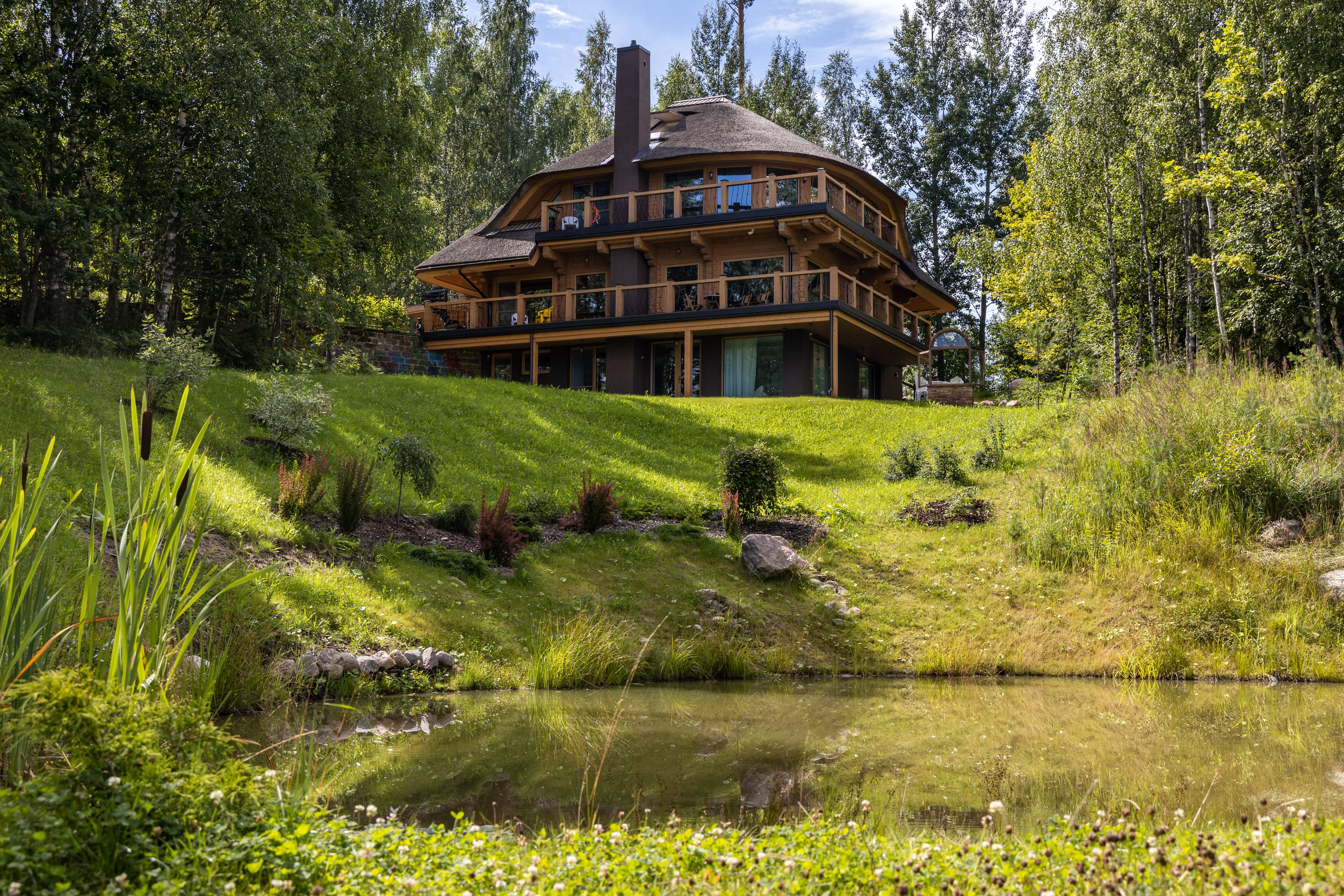
Among the venues available in the Baltic region, Narbuli Retreat House in Latvia has a distinct profile worth understanding on its own terms. Set on a forested hillside beside a glacial lake within the Amatciems eco-village, Narbuli is built around nine rooms, each designed around a different Jungian archetype—a structural choice that gives every retreat hosted there an additional layer of intention before a single session begins. This kind of archetypal retreat house design is unusual among European venues, most of which favour neutral, generic guest rooms.
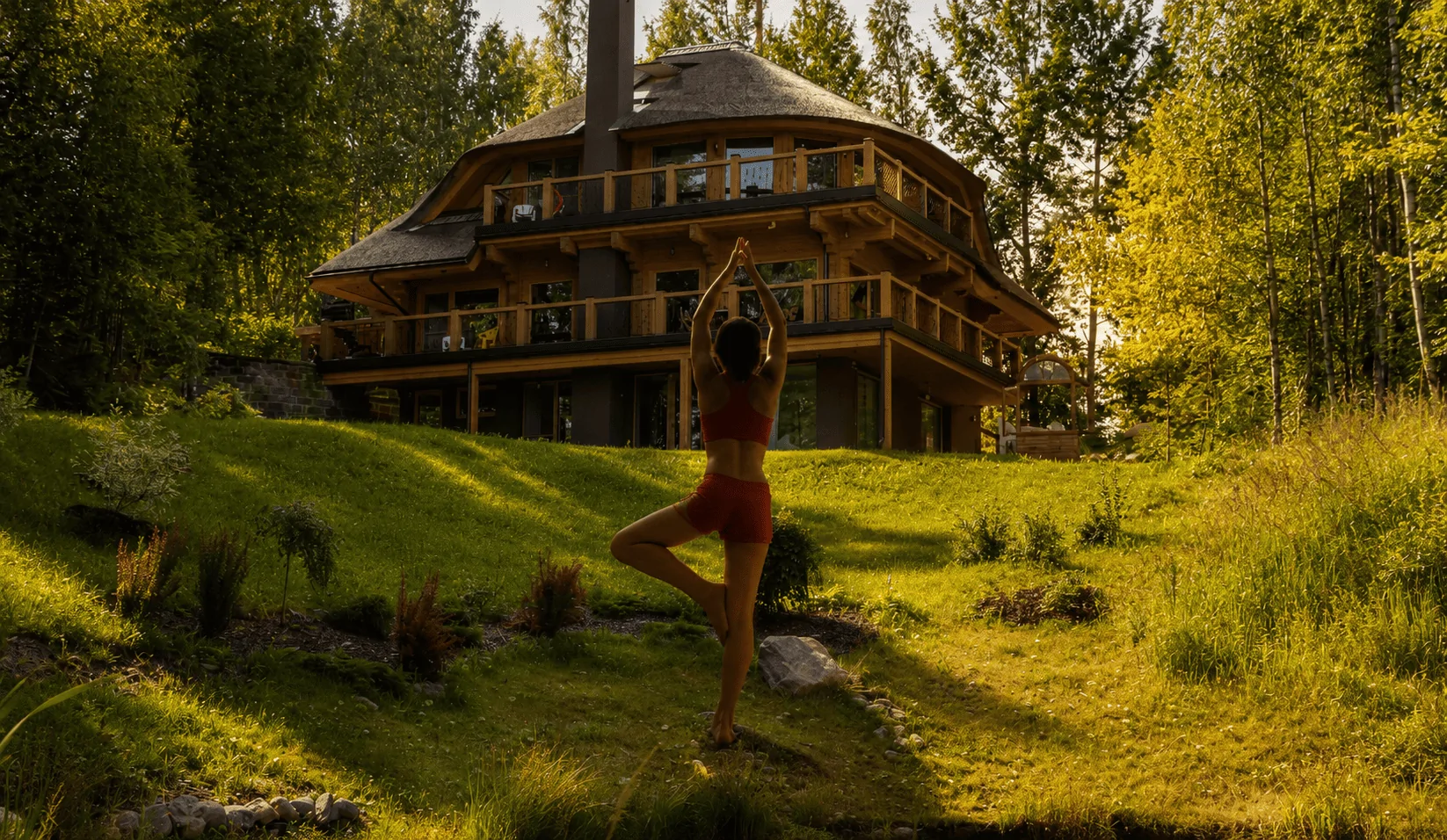
Narbuli Retreat House, Amatciems — forest, lake, and a dedicated 48 m² practice hall
What makes Narbuli distinct as a forest retreat venue
Whole-property exclusive hire. There are no other guests, ever, during a booking. Full control of every space—the practice hall, the kitchen, the lakeside terrace—for the entire duration.
A dedicated 48 m² practice hall, purpose-built for yoga, movement, or group work—not a converted lounge or function room.
Genuinely immersive natural setting. Latvia is over half forest, and Narbuli’s hillside position beside the lake gives every part of the stay—practice, meals, free time—a backdrop that supports the kind of presence a retreat is meant to cultivate.
Sleeping up to twelve across nine rooms, Narbuli suits the scale many independent teachers and solo travellers actually operate at: small enough for genuine group cohesion or solitude, large enough to make the economics of hosting work.
Including a traditional Finnish sauna, a lakeside meditation terrace, and on-site psychologist-coaches available to support deeper programme work for teachers who want to incorporate psychological elements alongside their practice.
The forest is not a feature you walk to—it is the immediate physical context of everything that happens at Narbuli. Trails begin at the door, and the lake is a short walk down the hillside.
Narbuli sits roughly 80 km from Riga Airport, with direct flights from London, Berlin, Oslo and other major European hubs typically running one and a half to three hours—meaning international participants can arrive without a long, fatiguing journey.
For a solo traveller, Narbuli offers a whole forest retreat house taken for yourself—or shared with a small group of friends—without the social dynamics of a shared retreat programme. There is no imposed schedule. For a retreat organiser, the value is in the combination of scale, exclusivity, and environment. Full details on hosting your own group retreat at Narbuli are available on the group retreat page.
How to Prepare for a Forest Retreat
The experience of a forest retreat begins long before you arrive. Proper preparation can significantly enhance the quality of your time in the woodland.
FAQ — Forest Retreats
Conclusion
The forest is not a metaphor for rest. It is a specific, measurable, physiologically active environment—one that human beings are adapted to benefit from, and one that becomes increasingly rare as urban life expands. A forest retreat is the sustained, intentional version of what happens when you step into the trees and stay long enough for the biology to catch up. Whether you are looking for a few days of genuine solitude, a facilitated shinrin yoku experience, or the right forested venue for a programme you want to host, the same principle applies: the forest does most of the work if you let it. The retreat is just the structure that makes staying long enough possible. Europe’s growing forest retreat landscape, from the Wye Valley to the Baltic states, now offers genuine depth of choice within a few hours’ travel of most of the continent—and for those seeking exclusive-use immersion at accessible costs, the Baltic forest is the region to know.
Ready to Experience a Forest Retreat at Narbuli?
Whole-property exclusive hire, a dedicated 48 m² practice hall, and a forested lakeside setting in Latvia—for solo guests and groups of up to twelve. Direct flights from London, Berlin, and Oslo.
What we offer




Comments